By SCOTT MCKIE B.P.
One Feather Asst. Editor
CHEROKEE, N.C. – Beau Carroll is a true educator who is passionate about his Cherokee culture and heritage. A member of the Eastern Band of Cherokee Indians (EBCI), Carroll is the lead archaeologist with the EBCI’s Tribal Historic Preservation Office.
Carroll is a quiet man, something I can relate to, but when he speaks, listen. He always has something poignant and important to say.
Always educating, Carroll was a presenter at the Kuwohi Connection Days held at Kuwohi in the Great Smoky Mountains National Park on Sept. 9, 2025. He told the students about this job noting, “Anything that’s important culturally, we are involved in and care for – special mountains like this place, rivers, mounds, archaeological sites, old towns, burials, historic cemeteries. We protect artifacts – tools, pottery, old baskets, carvings. We also protect stories and help keep language because that’s the way our people remember the past. Every story, artifact, tells us who we are and where we came from. So, by protecting them, we’re able to pass it on to future generations.”
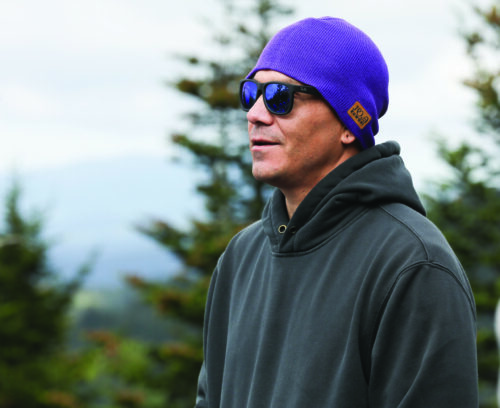
Beau Carroll, a member of the Eastern Band of Cherokee Indians (EBCI) and lead archaeologist at EBCI’s Tribal Historic Preservation Office, is shown at the Kuwohi Connection Day event at Kuwohi in the Great Smoky Mountains National Park on Sept. 9, 2025. (SCOTT MCKIE B.P./One Feather photo)
His work is not only inspiring for young students; it has been of vital importance to the preservation of Cherokee history. He helped lead and co-author a study entitled “Talking Stones: Cherokee syllabary in Manitou Cave, Alabama” that was published in the Cambridge University Journal of Antiquity Volume 93, Issue 368 in April 2019.
The study revolved around Cherokee syllabary being found in a cave in Alabama. Others working on the study included Jan Simek, Carroll’s advisor at the University of Tennessee; Alan Cressler, cave photographer; Julie Reed, then-associate history professor at Penn State University and a citizen of the Cherokee Nation; and Tom Belt, a Cherokee Nation elder and first language Cherokee speaker.
Carroll and Belt worked on the translations which described anetso (stickball) games. The first two inscriptions translated spoke of a stickball game in April 1828. The first one translated as “leaders of the stickball team on the 30th day in their month April 1828” and the second one read “we who are those that have blood come out of their nose and mouth” and included a signature of Richard Guess, Sequoyah’s son.
At the time, Carroll told the One Feather the importance of having Cherokee people at the forefront of the study. “Usually, studies like these are from the outside looking in because the people who are conducting the study are not Cherokee. This study is different because it has another point of view that is lacking in the academic world. This work was personal, and I felt I needed to show that Cherokee people haven’t had much of a voice in the archaeological community, but that was going to change. My main focus was to show the benefits of tribal consultation, and the work speaks for itself.”
In 2012, Carroll received the Outstanding Scholar Award from the College of Arts and Sciences Anthropology Department at Western Carolina University (WCU). He received a bachelor of arts degree in anthropology, archaeology, and Cherokee Studies from WCU that same year. He received a doctor of philosophy (Ph.D.) in archaeology from the University of Tennessee – Knoxville in 2025.
Carroll’s doctoral dissertation is entitled “We Have Come to Turn It: Merging Archaeological Practices with the Cherokee Concept of Duyudvi (‘the right way’ or ‘the right path’)”. His dissertation abstract states, “As the lead archaeologist for the Eastern Band of Cherokee Indians, I examine colonial legacies within the field and propose ways to allow for meaningful change through Indigenous-led collaborative work that incorporates community-based research and culturally grounded interpretations.”
It adds, “When Cherokee language expertise, traditional knowledge, and first-hand accounts are combined within cultural resource management, a more meaningful way to practice Indigenous studies emerges.”
The passion Carroll has for educating others on Cherokee culture is admirable and serves as a guide to others. Every day, he works to make sure that the field of archaeology has a Cherokee voice.