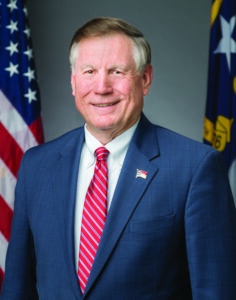
Mike Causey, N.C. Insurance Commissioner (Photo courtesy of N.C. Insurance Commission)
By Mike Causey
Insurance Commissioner
I’ve talked a lot about insurance fraud over the years. Americans pay $308.6 billion annually just to cover the cost of insurance fraud, according to a 2022 study conducted by Colorado State University for the Coalition Against Insurance Fraud. That’s an average of $932.63 for every American or nearly $3,800 for a family of four.
A major part of insurance fraud is health insurance fraud, including Medicare and Medicaid fraud. That 2022 study estimates that health insurance fraud totals $36.3 billion annually, with Medicare and Medicaid fraud costing an additional $68.7 billion. That totals $105 billion in insurance fraud just within our healthcare system.
Health insurance fraud may be initiated by a provider who bills for services that were never rendered. Or a provider may up-code a claim by billing for a more complex service with a higher reimbursement rate than the service that was provided.
A patient can also commit health insurance fraud. One way is for an uninsured or underinsured patient to provide a name and health insurance information of another person to the provider. Or an individual may use a computer program to create a fraudulent invoice to submit a claim for services that were not provided.
Artificial intelligence can also be used by perpetrators of fraud. Fraudsters can use AI to generate fake medical records to support fraudulent claims, making it more difficult for insurance companies to review the claims to see if they are legitimate.
On the flip side, AI can also help insurance companies analyze data on a larger scale and detect patterns that would otherwise escape the human eye. That could help insurance companies and health insurance members who pay their premiums.
Consumers can help fight fraud by being vigilant when it comes to claims being paid by insurance companies, Medicare or Medicaid. Carefully review your Explanation of Benefit (EOB) statements when you receive them.
EOB statements can be confusing. You need to review your EOB statements and ask your insurance company or provider questions if something isn’t clear. Look for red flags, such as being charged twice for the same service or being charged for medical equipment or services that you did not receive.
Such errors may be honest mistakes. Or they could be a sign of fraud. If you need help or are unsure, you may call consumer experts at the Department of Insurance weekdays from 8 a.m. to 5 p.m. at 855-408-1212. You may also visit www.ncdoi.gov.
I’m committed to fighting fraud. The Department of Insurance’s Criminal Investigations Division has special agents who specialize and are dedicated to healthcare fraud investigations. We partner with state and federal agencies to investigate Medicare and Medicaid fraud.
Insurance fraud is not a victimless crime. It costs us all every time we pay an insurance premium. Some estimates suggest that 20 cents of every premium dollar go to cover the cost of insurance fraud.
So far this year the Department has recorded $25.3 million in insurance fraud recoveries. I hope you’ll join me in this fight against insurance fraud and its impact on our pocketbooks.
For more information regarding health insurance fraud, please visit our webpage at www.ncdoi.gov/consumers/health-insurance/health-insurance-fraud.