By ROBERT JUMPER
Tutiyi (Snowbird) and Clyde, N.C.
For many years, your One Feather staff has been providing documentation of events in our community, in surrounding communities, in the state, region, and nation. No one outlet, especially with a total staff of five and only two of those routinely reporting, can physically cover all the happenings of interest to our community. To the best of our ability, we do get in items that you need to make decisions and to contact your elected officials when events and situations arise that will determine how you live in the community.
For example, our community is heavily invested in our youth, so you see a focus on school- and youth-sports-related materials in the One Feather publications. Tribal, federal, state, and local government actions are also of interest to the community, so you see a focus on legislative updates, executive actions, and judicial reports in the One Feather.
 When it comes to tribal governmental reporting, you will not see a One Feather reporter interpret a report or draw a personal conclusion inside an article or a data release. Oh, you will surely find opinions in the One Feather offerings, but only in commentaries like this one, editorials, and letters to the editor. When reporting news to our community, it is an ethical responsibility not to bias an article. We simply document what is and let the reader make their own determination and draw their own conclusions.
A reporter or journalist simply gathers information in the form of text, audio, pictures, videos, interviews, etc., and processes it into an understandable format for public consumption.
In my opinion, the One Feather has a duty to the community and readership to tell the truth, the whole truth, and nothing but the truth. And we balance that duty with a commitment to adhere to a specific ethical code set out specifically for journalists. The preamble to the Society of Professional Journalists Code of Ethics says, “Members of the Society of Professional Journalists believe that public enlightenment is the forerunner of justice and the foundation of democracy. Ethical journalism strives to ensure the free exchange of information that is accurate, fair, and thorough. An ethical journalist acts with integrity.”
This organization and code stand on four pillars or principles, including: seeking truth and reporting it, minimizing harm, acting independently, and being accountable and transparent.
In our Cherokee Code, the government recognized the need for that independent voice even in a government-funded media outlet. It was our own elected officials who voted in Chapter 75-51, 52, and 53 of the Code, which says, “This article will be the Free Press Act of the Eastern Band of Cherokee Indians. It is imperative to have measures in place to ensure the freedom of press and to ensure the tribal publications have the autonomy and independence to report honestly and objectively. The principles of free speech and free press, the rights of the people to assemble and petition for redress of grievances, shall not be abridged. The Eastern Band of Cherokee Indians Free Press shall be independent from any influence and free of any particular political interest. It is the duty of the press to report without bias the activities of the Tribe, the tribal government, and any and all news of interest to have informed citizens.”
Both the Editor and the Editorial Board of the Cherokee One Feather are bound by Code to maintain integrity when it comes to reporting to the EBCI community and readership. Section 75-57 says, “The staff shall not, directly or indirectly, solicit, receive or in any manner be concerned in soliciting or receiving any assessment, subscription, or contribution for any political organization, candidacy, or other political purpose. The staff shall not participate in any political campaign or be involved in any Tribal political activity, except to exercise their rights as citizens to express their individual opinion and cast their vote.”
So, when it comes to articles in the One Feather, we are bound by law to provide, as Joe Friday used to say in the old television series Dragnet, “Just the facts.”
Not only do we have a duty to be factual in our reporting, but we also must insist on truthful information from those wishing to provide data, events, and actions of individuals. While a letter or commentary submitter may express their opinions, they may not misrepresent data, events, and actions or slander someone. All information submitted to the One Feather represented as fact must be sourced.
If an editor, publisher, or reporter allows their articles to be infected with their personal biases, they are no longer journalists. They are storytellers. They may as well be sitting at a bar with their buddies telling tales. Instead of documenting history, they end up telling historical fiction. Unfortunately, newsrooms are becoming slaves to economic and corporate interests. And their credibility as journalists representing a community suffers. In the end, only those readers with like beliefs will gravitate to a media outlet that espouses those beliefs. The rest of a community or readership will move on to attempt to find an unbiased outlet, or they will give up on news media altogether.
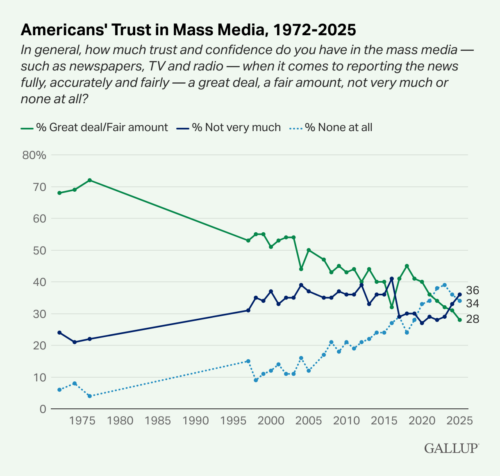
According to recent polling, communities and readers are doing exactly that.
Megan Brenan reporting for Gallup (news.gallup.com) says, “Americans’ confidence in the mass media has edged down to a new low, with just 28 percent expressing a ‘great deal’ or ‘fair amount’ of trust in newspapers, television and radio to report the news fully, accurately and fairly. This is down from 31 percent last year and 40 percent five years ago. Meanwhile, seven in 10 U.S. adults now say they have confidence, (36 percent) say ‘not very much’ or ‘none at all’ (34 percent).”
As I have said in previous commentaries, news organizations become their own worst enemies when they choose sensation over fact. And when an organization or a writer decides that its view or opinion of facts is more important than the facts themselves, the truth gets lost in supposition. I hold some passionate opinions on a variety of actions by governments and special interest groups. I know that if I leverage the tribal newspaper, skewing the facts to suit my beliefs, then I have become a political self-interest group and have violated my duty and the ethical code. And then I have given the community and readership a reason to distrust me and the newspaper.
By comparison, we are a small news organization. We don’t have the regional resources that some outlets do. But we have a community and leadership that knows we will not mislead them based on any political bias, whether that be for a politician, a government, or a special interest group. Reports we receive from the government are not altered by the One Feather (only children’s names, information, and enrollment numbers are removed should they come in on a report). We transcribe information from meetings and put those reports out to the public. And when we cover stories that require interviews, those quotes are documented with attributions, so readers know who said what. We don’t bully. We respectfully questions and give opportunity for comment. We don’t suppose when we do not know. We gather news and report the facts without bias to the public, to the best of our ability. And that is what journalists do.