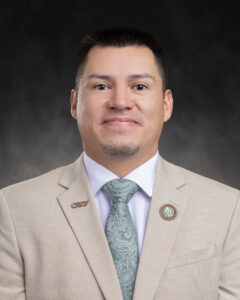
Aniwodihi (Painttown) Rep. Michael Stamper (Photo contributed)
Hello everyone,
This is my Council Report for the month of April. Before I begin, I want to congratulate Anna Ferguson on becoming the first EBCI (Eastern Band of Cherokee Indians) member to serve in the North Carolina House of Representatives. She will represent District 119 for the remainder of this term. Anna Ferguson has made history as the first woman to serve as the House Representative for District 119, and she is also a proud member of the Painttown Community. As always, my report follows the standard format below.
Community Events
April 27 – Painttown Community Club Meeting
Please join us for our monthly community club meeting. We discuss upcoming community events, review upcoming council agendas, and answer questions community members may have on a range of topics. This month, we will nominate and vote for the officer position of Secretary.
Time: 5:30 p.m. – 6:30 p.m. Location: Painttown Community Club Building
April 28 – Cherokee Autism/IDD Celebration 2026
QBHS & EHS and FSN of NC are hosting the annual Cherokee Autism/IDD Celebration to engage, celebrate, and bring together an important part of our community. There will be special guest speakers from the Cherokee Indian Hospital, EBCI community members, and Dr. El Brown, Founder of Kinderjam.
Time: 3 p.m. – 7 p.m. Location: 1501 Acquoni Road, Cherokee, NC 28719
Project Updates
Recently Completed Projects
This list will be updated as projects are completed throughout the 2026 calendar year.
Projects Currently Underway or Nearing Completion
Nvdiyeli Trail
The project is complete. A ribbon‑cutting date will be shared as soon as it becomes available. Signage is currently being created. (No change from March report.)
Ceremonial Grounds
Groundwork has been contracted and is currently underway. (No change from March report.)
Multipurpose Facility (Old High School Site)
This project remains in the design and development phase. A completion date has not yet been determined. (No change from March report.)
New Restroom Facilities for the Historical Area (Indian Village and Fire Mountain Trails)
Designs have been approved, and the bid process has begun. After bids are collected, a budget will be drafted for project implementation. (No change from March report.)
Ordinances
(Any ordinance that has been passed, killed, or withdrawn will not appear on this list.)
- Amendments to the Judicial Code, Chapter 7 of the Cherokee Code
- Compliance with NC State requirements for Underground Storage Tanks
- Amendments to election laws
- An ordinance establishing an Elk Hunting Season
- An ordinance to establish the EBCI’s digital sovereignty
- An ordinance to amend Chapter 55D to provide that revenues obtained by EBCI Holdings, LLC from the Caesars Southern Indiana Casino, and distributed to the Tribe, shall be allocated to the Tribe’s General Fund and Debt Service Sinking Fund
- An ordinance amending Chapter 47E to ban data centers on EBCI Trust Lands
Work Sessions
Upcoming Work Sessions – April 28
- 1 p.m. – Discussion with Housing and Cardinal Homes
- 2 p.m. – Discussion with Kituwah LLC
- 3 p.m. – Discussion about HELP Ordinance
Monthly Update for Readers
This month’s topic focuses on the rules that provide a framework ensuring meetings are conducted fairly, efficiently, and with respect for the rights of all members. These rules are commonly known as Robert’s Rules of Order.
To begin, no—these are not rules made up by a local Robert. They are a set of procedures developed by General Henry M. Robert in 1876. Over time, updates have been made to ensure meetings remain orderly and effective.
A basic meeting structure found in most professional environments includes:
- Call to Order: The Chair opens the meeting and confirms a quorum.
- Approval of Minutes: Members review and correct previous meeting minutes.
- Reports: Members and officers present reports.
- Old Business: Unfinished items from previous meetings are addressed.
- New Business: New proposals are introduced and discussed.
- Adjournment: The meeting is formally closed.
This structure outlines the typical order of business. How members conduct themselves during the meeting is guided by Robert’s Rules of Order. Motions are the tools used to move items along. They require a second before proceeding to a vote, ensuring at least two members believe the action is worth consideration. Common phrases such as “move to approve,” “move to table,” and “move to kill” are used to address agenda items.
For a typical Tribal Council agenda, the Chair opens the session with a prayer, then opens the floor for any proposed changes to the agenda. If no changes are submitted, new items are addressed based on whether they are resolutions or ordinances. When new ordinances are submitted, a motion is made to “read, give a number, and table,” meaning the ordinance is read, assigned a number for the record, and tabled for the mandatory 25‑day minimum to allow for public comment. Once new ordinances are addressed, the remaining items can be acted on. Tabled items are discussed first, as they fall under old business.
Once an agenda item is on the floor, members may debate it, propose amendments, or suggest substitutes. Amendments can add, strike, or replace words. Debate continues until members are ready to vote. If an item stalls—meaning there is no further discussion and no motion—the Chair may note that, due to the lack of a motion, the item dies on the floor. This indicates the item did not have enough support for action and will be removed from future agendas. If an item has a motion and a second to pass, a majority vote is required.
These actions will continue until all items on the agenda have been addressed.
There are times when more than one motion is on the floor for a particular item. For example, if an item has both a motion to pass and a motion to table, which one is acted on first? Under Robert’s Rules, the body must take up the lesser action first. In this case, the motion to table is considered first because it does not call for an immediate decision on the item. If the motion to table receives a majority vote, the item is tabled and the motion to pass is not acted upon. If the motion to table fails, the motion to pass is then considered.
The Chair is responsible for running the meeting and must follow a set of rules understood by all members. This ensures that everyone knows how to conduct themselves appropriately and efficiently. While there are established rules every meeting should follow, additional language can be drafted to provide clarity in situations where complicated scenarios arise.
With all of this said, I hope it highlights the importance of the Chair position and the knowledge and experience required to conduct a meeting properly. When meetings are not conducted in this manner, order is lost and emotions can take over.
While we are all human and can become overwhelmed with emotion when discussing issues we care deeply about, we must always remain respectful of one another. If each of us understands that we all play a role in how a meeting is run, we can ensure that meetings are conducted in a manner that reflects well on our Tribe. I deeply admire the passion our community shows every day. I will always respect anyone who chooses to speak on any topic, and I ask only that the same respect be extended to every other member when it is their turn to speak.
I hope this article provides clarity on how meetings can be conducted when a set of principles and procedures is followed. While this is a generalized overview, it is not meant to imply that every meeting must follow this exact structure. Flexibility is encouraged so that meetings can be conducted in the way that best suits the order of business for all involved.
Michael Stamper
Tribal Council Representative
Painttown Community
828-736-6192