By SCOTT MCKIE B.P.
One Feather Asst. Editor
YANCEY COUNTY, N.C. – An area in Yancey County that contains a rare rivercane patch is being preserved, and artisans of the Eastern Band of Cherokee Indians (EBCI) will be able to harvest some for traditional weaving.
Caleb Hickman, EBCI Fisheries and Wildlife Management supervisory biologist, noted, “The Southern Appalachian Highlands Conservancy (SAHC), with support from the Office of Fisheries and Wildlife Management for Eastern Band of Cherokee Indians (EBCI), and the North Carolina Land and Water Fund recently finalized the permanent protection of the 433-acre Cane River Confluence property in Yancey County. The site lies where the Toe and Cane Rivers join to form the Nolichucky – a place of ecological rarity and deep Cherokee cultural significance.”
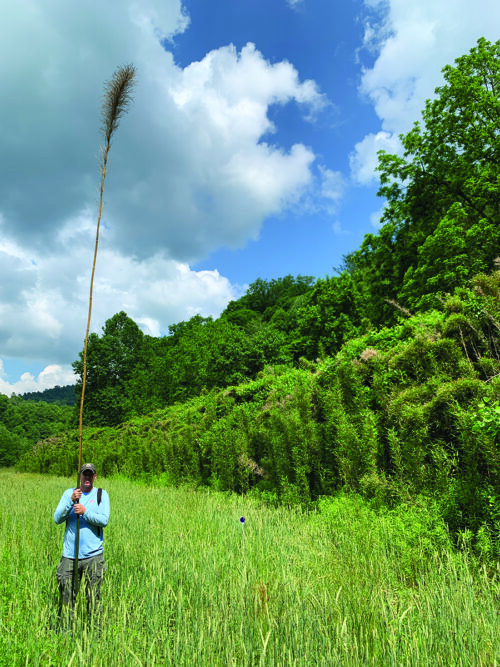
Caleb Hickman, EBCI Fisheries and Wildlife Management supervisory biologist, is shown at the 433-acre Cane River Confluence property in Yancey County. (Photos by Adam Griffith/EBCI Cooperative Extension Office)
The land is now owned by SAHC who will operate under a land management plan that will allow EBCI artisans access for harvesting sustainably.
He said that EBCI artisans were able to access the area in 2021 through RTCAR (Revitalization of Traditional Cherokee Artisan Resources) and the previous owners. “They (RTCAR) knew that it would have substantial potential for artisans because of the size of the cane patch. The size of the cane patch is a very rare find because of the height and also individual clones – the cane itself is very big around and that’s what artisans prefer.”
Hickman added, “I worked up a project with a graduate student through the University of Georgia to assess how artisan harvest would affect the growth of the patch and the success of the patch, if it was a good traditional ecological knowledge system for harvesting, and to also evaluate the patch as an ecosystem because it was substantial. We thought it would be a great example of what we want to see in a rivercane patch throughout its range. We’ve lost 98 percent of rivercane throughout its range in the southeast. So, we want to restore it. For restoration purposes, scientific purposes, and artisan purposes, the patch is super important.”
Michellle Pugliese, SAHC land protection director, commented, “From a water quality perspective it was really important to protect. And, just the size of the property also as a stand-alone, intact, forest resource – not only mature forest but also early successional forest where there’s a meadow that provides good habitat for migratory birds and other species. When we learned about the rivercane and the significance of the rivercane to the Eastern Band of Cherokee Indians for local artisans, and rivercane also from a biological standpoint as stabilizing riverbanks – there are so many reasons this property became a very high priority for us to preserve.”
She went on to say, “We still have a lot of work to do to secure the property even though we do own it. Since we purchased the property using some loan funds, I am working with the N.C. Land and Water Fund to receive that grant to repay the loan. We intend to own it for the long-term as a preserve that we’re calling the Cane River Confluence.”
Chris Kaase, SAHC stewardship and GIS manager, said he is looking forward to expanding the relationship between the EBCI and SAHC. “To have this opportunity to work with the Eastern Band for purposes of resources and research that are important, both culturally and for arts and everything else, is a real opportunity.
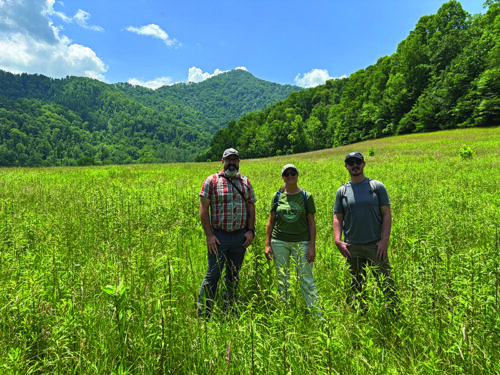
Shown, left to right, at the site are Damon Hearne, North Carolina Land and Water Fund field representative for the Western District; Michellle Pugliese, SAHC land protection director; and Chris Kaase, SAHC stewardship and GIS manager.
All in all, this partnership is just a big win-win, I think, for everyone. Once we get land that we own protected through the mechanism of ownership, we then take a year to write what is called a Land Management Plan. So, it’s our guide for how we intend to manage this property over the short term. Then we revisit those things over time. So, we are looking forward to that collaborative process with these goals in mind. Again, it’s just a real opportunity for everyone to come in and be a part of managing this property for all that it is important for.”
Kaase said they plan to formalize the agreement with the EBCI soon. “In the next steps, we will identify the things that we want to provide for on the property, then formalize that into some sort of MOU or agreement. Then, that will essentially provide for the ability of people to get on the land in whatever way that we do collaboratively. I imagine that is going to be conversations amongst us to figure out how best to put that together.”
Pugliese added, “Both Chris (Kaase) and I are going to be working with the Eastern Band and the artisans to manage that relationship and formalize the commitment that we have to make sure that that rivercane continues to be accessible to the Cherokee.
A condition of receiving the money from the State of North Carolina is that they have to place a conservation easement over the property…which places permanent restrictions on development and subdivision of the land. The State of North Carolina is going to hold that conservation easement. SAHC will be responsible for monitoring the easement.”
Hickman spoke of the importance of the site. “This is super rare. It’s already an endangered environment – we’ve lost 98 percent of it throughout its range. So, when you talk to an ecologist about endangered species, that’s one of the factors you look at is the distribution of where it used to be versus where it is now and how is it going to progress. It’s clonal, so underground they’re all connected, it’s not individual plants. It’s basically a large single organism. So, it’s a very different way to look at this. That’s a very productive site for a few reasons – it hasn’t been cut for a while, but it’s also a different site because it’s not right up against the river. So, the management of that site will be super important to do it right.”