By SCOTT MCKIE B.P.
One Feather Asst. Editor
CHEROKEE, N.C. – The North Carolina Advisory Council on Cannabis will begin meeting soon, and a member of the Eastern Band of Cherokee Indians will be at the table. Forrest Parker, Qualla Enterprises, LLC general manager, has been selected to serve on the Advisory Council.
According to Executive Order No. 16 on June 4, 2025 by North Carolina Gov. Josh Stein, The North Carolina Advisory Council on Cannabis was established and “shall study and recommend options for a comprehensive statewide approach to cannabis that is grounded in public health and public safety considerations, informed by lessons from other states and experts, and focused on the protection and safety of North Carolinians, especially our youth”.
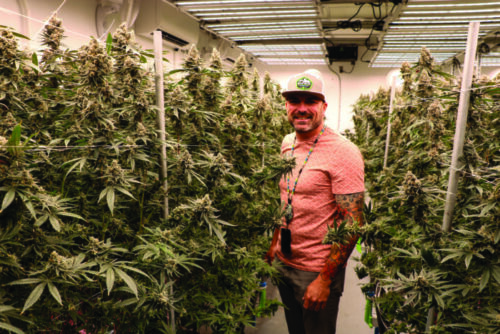
Forrest Parker, a member of the Eastern Band of Cherokee Indians who serves as the Qualla Enterprises, LLC general manager, has been selected to serve on the North Carolina Advisory Council on Cannabis. (SCOTT MCKIE B.P./One Feather photo)
Parker is very proud of the cannabis operation he oversees.
The Great Smoky Cannabis Co., located in Cherokee, N.C., opened to the general public for sales of adult-use cannabis on Sept. 7, 2024. The dispensary is operated by Qualla Enterprises, LLC, an entity of the Eastern Band of Cherokee Indians (EBCI), which also operates a cannabis farm in Tsisqwohi (Birdtown) which supplies the dispensary.
“We are the largest vertical cannabis operation in America. We are the world’s largest dispensary, and I have no problems saying that right now. And, we have done all of that right here in Cherokee, with Cherokee, for Cherokee. We are positioned now to be the strongest partner the state could possibly have to help lead and guide, bring them to our project, use what the Cherokee have done to create the largest vertical, the world’s largest dispensary, and one of, if not the most regulated, safest cannabis operations in America.”
Part of the Advisory Council’s job will be to set policy for the State of North Carolina regarding the regulation of cannabis – something Parker is very comfortable with and doing. “Our Tribe has enforced a very stringent code. The health and safety aspects have been paramount since day one. We’ve never fought against it. We have just built towards it and built to it because we knew that if our health and safety were the king, the gold standard – we always want to be the gold standard for health and safety because as North Carolina starts entering into these conversations of what does regulated cannabis look like for us, we want to be the perfect example.”
Parker is very excited about the opportunities his selection opens up. “Our seat at this table doesn’t just give us a seat as ‘this is how cannabis policy impacts the tribe’. This truly allows us to go, ‘we’re a trend-setter. We’re a groundbreaker here. We pioneered this.’”
He added, “My goal, and our goal, and why this is so special, is now we get to not only have a seat at that table, we get to help educate and inform on the real process. We get to bring those people here to show them what our people have done through sovereignty with our own people in a very, very challenging system of agriculture, manufacturing, and retail.”
Gov. Stein said in a statement when establishing the Advisory Council, “Our state’s unregulated cannabis market is the wild west and is crying for order. Let’s get this right and create a safe, legal market for adults that protects kids.
That is why I am announcing a State Advisory Council on Cannabis. I am charging this group with studying and recommending a comprehensive approach to regulate cannabis sales. They will study best practices and learn from other states to develop a system that protects youth, allows adult sales, ensures public safety, promotes public health, supports North Carolina agriculture, expunges past convictions of simple THC possession, and invests the revenues in resources for addiction, mental health, and drugged driving detection.”
Parker noted that he is proud of the exercise of sovereignty that the EBCI has done with its cannabis operation. “This entire time, we have always wanted to be the leading example for our state so when they enter into that journey, we were the gold standard – not just in North Carolina or the south, but honestly, the nation. Now that time is coming. Now, not only have we built the largest complete vertical system in America where we’ve sold over 1 million individual products since we opened adult-use, and developed over 350 proprietary, individual SKUs while supporting over 90 percent tribal families.”
He further noted, “The goal has always been to collaborate and interact with our state system in ways that benefit this business and, thus, the Cherokee people. I think over the next period of time as the system gets refined and the actual cannabis program in North Carolina gets truly developed and rolled out, we will be able to define how we interact in that system much better.”
According to Gov. Stein’s office, the members of the North Carolina Advisory Council on Cannabis are as follows:
Co-chairs
- Lawrence H. Greenblatt, MD, State health director & chief medical officer, North Carolina Department of Health and Human Services
- Matt Scott, district attorney, Prosecutorial District 20 (Robeson County)
Members
- David W. Alexander, owner and president, Home Run Markets, LLC
- Arthur E. Apolinario, MD, MPH, FAAFP, 2002-2023 past president, North Carolina Medical Society; Family Physician, Clinton Medical Clinic
- Joshua C. Batten, assistant director for special services, Alcohol Law Enforcement Division, North Carolina Department of Public Safety
- Representative John R. Bell, North Carolina House of Representatives, District 10
- Carrie L. Brown, MD, MPH, DFAPA, chief psychiatrist, North Carolina Department of Health and Human Services
- Mark M. Ezzell, director, North Carolina Governor’s Highway Safety Program, North Carolina Department of Transportation
- Anca E. Grozav, chief deputy director, North Carolina Office of State Budget and Management
- Representative Zack A. Hawkins, North Carolina House of Representatives, District 31
- Colonel Freddy L. Johnson, Jr., commander, North Carolina State Highway Patrol
- Michael Lamb, police chief, City of Asheville Police Department
- Peter H. Ledford, deputy secretary for policy, North Carolina Department of Environmental Quality
- Kimberly McDonald, MD, MPH, Chronic Disease and Injury Section chief, Division of Public Health, North Carolina Department of Health and Human Services
- Patrick Oglesby, attorney and founder, Center for New Revenue
- Forrest G. Parker, general manager, Qualla Enterprises LLC / Great Smoky Cannabis Company
- Senator Bill P. Rabon, North Carolina Senate, District 8
- Lillie L. Rhodes, legislative counsel, Administrative Office of the Courts
- Gary H. Sikes, wwner, Bountiful Harvest Farm and Partner, Legacy Fiber Technologies
- Senator Kandie D. Smith, North Carolina Senate, District 5
- Keith Stone, sheriff, Nash County
- Joy Strickland, senior deputy attorney general, Criminal Bureau of the North Carolina Department of Justice
- Deonte’ L. Thomas, chief, Wake County Public Defender Office
- Missy P. Welch, director of programming (Permits/Audit/Product Sections), Alcoholic Beverage Control Commission