
By RENISSA MCLAUGHLIN
EBCI Youth and Adult Education director
When I spoke with Ava Walkingstick, Youth of the Year Nominee, her Cherokee Youth Center Manager, and the chief executive officer of the Boys & Girls Club of the Tar Heel Region, I expected to hear a success story. What I heard was something deeper — a testament to what happens when a community refuses to leave its young people behind.
Ava Walkingstick, a member of the Eastern Band of Cherokee Indians, was 5 years old when she first walked through the doors of the Cherokee Youth Center. She is 17 now—a junior at Cherokee High School, the current Teen Miss Cherokee, a member of the Birdtown Community, and this year’s Boys & Girls Club Youth of the Year nominee for North Carolina, where she earned third place in the state competition. When I spoke with her after the ceremony, it was clear why she had been nominated. It was right there in the way she carried herself: in the steadiness of her voice and the warm smile she extended to everyone in the room.
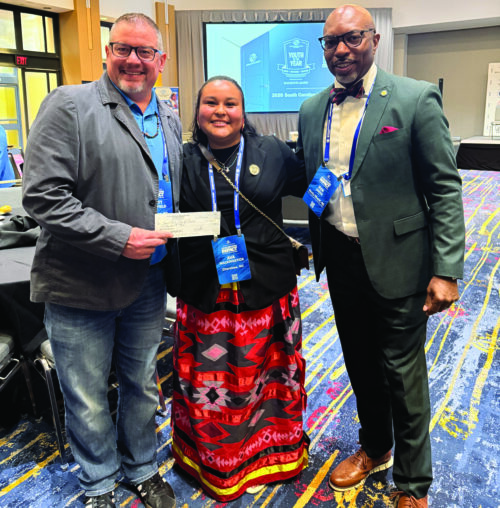
Matthew Hollifield, Cherokee Youth Center manager; Ava Walkingstick, Youth of the Year nominee; and Ron Green, Boys & Girls Club of the Tar Heel Region chief executive officer. (Photos contributed)
13 years is a long time to show up anywhere. But Ava has shown up—to the art programs, the soccer clinics, the Vacation Bible School, and every other opportunity the center has offered—year after year, summer after summer. And this year, the Cherokee Youth Center asked her to show up on a bigger stage.
She did not hesitate.
On Tuesday, April 29, the Boys & Girls Clubs of America held its combined North and South Carolina Area Council Youth of the Year Celebration in Charlotte, North Carolina — bringing together honorees, families, club staff, and community leaders from across both states to recognize the region’s most outstanding young people. I was moved by what I witnessed there—not just by Ava, but by the full picture of what this program represents.
Ivy Chin, one of this year’s judges, put it plainly when she addressed the audience and the honorees gathered from both Carolinas:
“The BGCA National Youth of the Year program is the highest honor a club member can receive. Every young person in that room has achieved in the classroom, demonstrated leadership, and served their community. Every one of them was worthy of the title.”
That is not a small thing. Hundreds of deserving young people are recognized through this program each year—young people who, with the help of their clubs and youth centers, have built something real inside themselves. Something that will carry them forward regardless of what comes next.
Ava competed against ten peers in the regional round, stood among three finalists, delivered a speech, and sat for interviews with the judging panel. When I asked her to share what the Cherokee Youth Center has meant to her, she did not hesitate.
“The youth center has given me so many opportunities—to make memories and carry those on. They’ve taught me how to public speak, how to make new friends, how to socialize, and how to be a team member and a leader at the same time.”
What struck me most was not the polish of her words, but the fact that she meant every one of them. This was not a performance. This was a young woman accounting for her own formation, clearly and gratefully.
I asked her what she would say to other teens in this community who have not yet found their way to the center. She did not recite a talking point. She talked about her friends—about the culture of mutual support she found among her peers, even under the competitive pressure of the Youth of the Year process. When asked about her experience in the competition, she said, “We are all definitely supportive of each other. I think that is one thing you can mostly get out of it—making new friends and having people there who are supportive of you. It is definitely one of the most memorable times you are ever going to have.”
I asked Matthew Hollifield, Cherokee Youth Center manager, why Ava had been nominated this year. His response was simple and said with conviction, “Ava is just an outstanding young lady. She represents the youth center, the Boys & Girls Club, and what they stand for very, very well. We couldn’t ask for anybody better to represent us and the tribe.”
Hollifield told me he is already looking toward next year, hopeful that Ava will return to compete again and, in his words, “do it even better.” That kind of institutional confidence is not handed out lightly. It is earned—the way Ava earned it: one year at a time, one program at a time, one act of leadership at a time.
Ron Green, Boys & Girls Club of the Tar Heel Region chief executive officer, addressed Ava directly at the Charlotte celebration when he presented her with a check for $500 in recognition of her being named third place. He was not simply congratulating a finalist. He was speaking to a young woman standing at the edge of her future, and he wanted her to know that her community was standing there with her, “We just want to say thank you for all that you do. It has been such an amazing journey. We hope that this can help further whatever you decide to do — in your post-secondary education, or going into the workforce.”
Those words matter. Because the Youth of the Year is not just a title or a trophy. It is a statement of investment—an organization saying, clearly and publicly, that it sees a young person, believes in them, and intends to help carry them forward. Ava Walkingstick has earned that statement.
At the close of our conversation, I asked Ava whether she plans to come back and compete again next year. She smiled—a real smile, not a polished one—and said, “Hopefully.”
I believe in her. And I think anyone who meets her will too.
There is a version of this story that is simply about a talented teenager earning a well-deserved honor. But the version I witnessed—in Ava’s words, in Matthew Hollifield’s pride, in Ryan Green’s direct address to her future—is about something larger. I also saw it in the faces of the community that was there in Charlotte to support her: Beth Grant, Youth Center board member; Tevy West and Tiffany Cooper, Youth Development Professionals at the Cherokee Youth Center; and especially her grandmother, Suzette Sanchez. It is about what a youth center can be when it takes its mission seriously. It is about what a young person can become when she is supported by her community.
Ava Walkingstick has been walking through those doors for thirteen years. The Cherokee Youth Center, its staff, her family, and her community have been walking with her. That partnership — quiet, consistent, and profoundly Cherokee — is the real story worth telling.