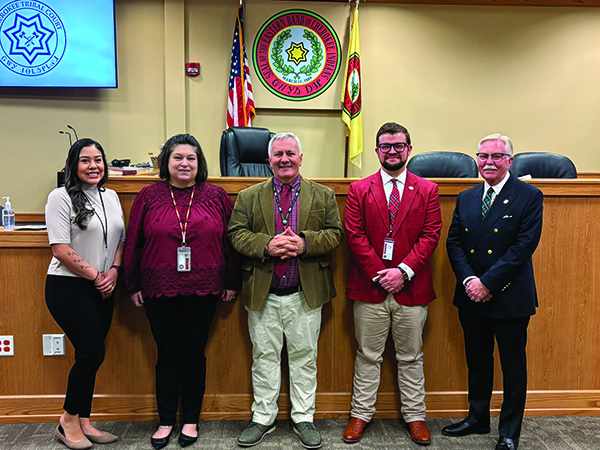
The EBCI Office of the Tribal Prosecutor is shown, left to right, including Amy Teesateskie, Hali Silvers, Leo Phillips, Hayden Duncan, and Randle Jones. (Photo contributed)
By BROOKLYN BROWN
One Feather Reporter
CHEROKEE, N.C. – The Eastern Band of Cherokee Indians (EBCI) Office of the Tribal Prosecutor is now fully staffed for the first time with a staff of five: Leo Phillips, lead tribal prosecutor; Randle Jones, senior tribal prosecutor; Hayden Duncan, tribal prosecutor; Amy Teesateskie, paralegal and victim/witness coordinator; and Hali Silvers, victim advocate. Teesateskie and Silvers are both enrolled members of the EBCI.
Duncan said that operating with a full staff has significantly improved the capacity of their office, “Now that we’re fully staffed, you sort of leave survival mode. So, one thing that we have been trying to do is meet more with law enforcement, take a more proactive stance in doing trainings for them or speaking with them one-on-one. I know that we’ve definitely talked to victims a lot more, too. Just having three of us at any given time is a huge, huge aspect of that. So, I think that that’s our big thing, is just expand our ability to talk to folks in the community, whether that be law enforcement, victims, or just community members who want to learn more.”
Phillips said serving the community is a priority. “This community has given me a lot – friendship, fellowship, food, and a chance to really grow. Representing individuals in the community, two of the first ones were Alfred and Maybelle Welch. That’s a really big shout out to them because they’ve been with me all throughout the whole thing. So, they mean a lot to me. And there’s others like that, too numerous really to go into. I still live in Murphy. I commute every day, and I just feel like it’s a real blessing to be here.”
Phillips worked in private practice for 35 years handling child custody and felony criminal defense. He worked in Graham Co., Swain Co., Macon Co., Clay Co., and the Qualla Boundary, as well as the towns of Andrews and Robbinsville.
Jones served as the Assistant District Attorney for the 24th Judicial District handling murder cases, major crimes, and violent felonies. Jones previously served the tribe as an associate judge from 2017-21. Jones was unavailable for interview. Read more of his biography here.
You can also find biographies for the rest of the team and namely Amy Teesateskie, who was also unavailable for interview, here.
Duncan shared,
“I was born in Sylva, grew up in Murphy. I went to Murphy High School. And after that, went to Campbell for both graduate and undergraduate. I was a prosecutor in a couple of other counties out near Charlotte, Gaston and Catawba, mostly. I was a DSS lawyer for about a year doing child protective services, but I grew up out here and had been out here quite a bit, so when this came open, I knew I wanted to be back home.”
“I was also a little bit burnt out from, I think, state government. There’s just not a lot of resources there to do much of anything positive, and I was working in communities where we weren’t seeing really much of any positives and particularly seeing anything that you were doing was making an impact,” he said.
I know Cherokee is a community that actually tries to help their folks get back on track and provide them resources to do so.”
Duncan emphasized some of the resources the tribe has that are transformative in his experience as a prosecuting attorney. “It’s a cycle, and a lot of these offenders, they grew up with that, or they don’t know any better or know that there’s an alternative out there. But these folks are part of a tribe; They are part of a central community and for the most part, they don’t leave. In state court, you had sort of a phenomenon that a lot of those folks were transient. They’d commit a crime in one place and then they’d flee to a different city or state.”
Here, that doesn’t happen. So, you either deal with the issues head on and you try and get to the root cause, or they’re just going to continue to do it here over and over and over again. Analenisigi [Recovery Center], for example, is huge for this community and for trying to just get at some of the structural issues that a lot of these folks face. And it’s not just one issue; a lot of the time they’re dealing with several issues, whether it’s substance abuse, alcohol abuse, domestic violence, trauma, and they all feed off each other. So being able to provide a place for a comprehensive evaluation is incredible.”
Phillips added, “You have a tremendous amount of services. You got them not only here on the Boundary, but you also are partnered with facilities around the country that you can send these individuals to if they really need some time alone, away from the community to work on what they have experienced in their lives. So, it truly is a restorative court system, whereas with the state court system, and more so with the federal government, it is all based on punishment. So, you don’t get the opportunity to really see someone not only get their children back, but to go on and be a productive member of society to where they’re contributing back and they’re raising a family. Here, we do see that. And that’s what makes it so rewarding at my stage.”
Phillips shared, “We also we have Hali and Amy who respond individually to the victims or law enforcement, too, with us to find out, is there something that can be worked out with a plea? Do we need active time? Do we need a split sentence? So, we’ve got lots of resources, and when you have someone like Judge [Barbara “Sunshine”] Parker on the bench, who I can’t say enough good things about, I mean, she’s been fantastic. I’ve seen her when she first started all the way through now and I just am like, ‘Oh my gosh, you finally have not only an enrolled member, but someone that is very in tune to what the community needs.’”
Silvers, who has a master’s in criminal justice and is currently pursuing a paralegal certificate course, said one of her current goals is strengthening communication with victims. “One of my goals is just making sure we get victim contact information because that’s been one of our big issues is contact information isn’t given, which makes it hard for us to contact them to give them updates on court. So, I’m trying, with the help of my office, to get a form that victims can have so it gives all the information we need.”
Silvers added, “There’s times that maybe a DV case comes in at four o’clock on Monday morning, so we have to rush around, and it makes it hard if I don’t have contact information for the victim. I just want to stress that providing contact numbers and up-to-date contact information is important.”
The EBCI Office of the Tribal Prosecutor has a Facebook page where they share important updates and even source the community through posts to get in contact with victims and witnesses. Follow their page.
“We’re open, and we’re happy to help where we can, or point you in the right direction,” Phillips said. Their office is located in the front building of the old BIA offices on Tsali Boulevard.