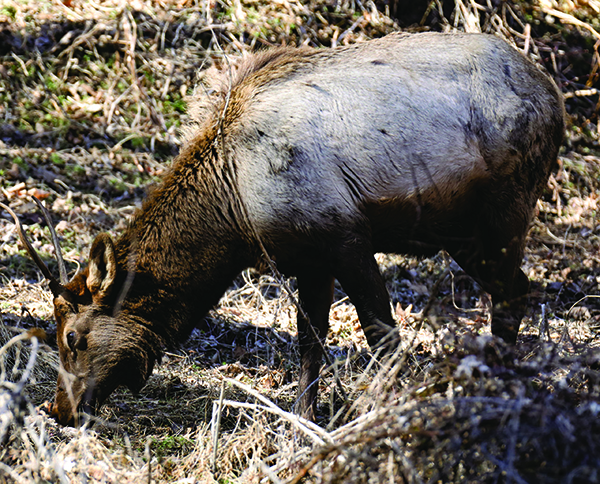
This elk was spotted eating a snack in Elawodi (Yellowhill) in Cherokee, N.C. on the sunny afternoon of Friday, Feb. 13. (SCOTT MCKIE B.P./One Feather photo)
By SCOTT MCKIE B.P.
One Feather Asst. Editor
CHEROKEE, N.C. – An ordinance, submitted during the March session of Dinilawigi (Tribal Council) and seeking to establish an elk hunting season on lands of the Eastern Band of Cherokee Indians (EBCI), was discussed during the Monday, March 16 session of EBCI Timber Committee. Ord. No. 135 was discussed in Timber Committee because that body, along with the EBCI Natural Resources Dept., submitted the legislation.
The whereas section of the legislation states, “Currently, the Tribe allows for the hunting of various animals, but not elk; and it is now possible to establish a limited elk season which balances increased hunting opportunities for enrolled members and the responsible management of the elk population on tribal lands.”
This ordinance seeks several changes to Cherokee Code Chapter 113 including removing the word “elk” from Sec. 113-5(a)(6) which currently states, “It shall be unlawful to hunt, trap, kill, or take any bird of prey or elk.”
It also seeks to add subsection (g) in Section 113-8 (Big Game) as follows:
(g) The season for hunting elk shall be Oct. 1 through Nov. 1.
(1) Hunting elk shall be by permit only as issued by the Natural Resources Department.
(2) The bag limit for elk is one per permit.
(3) A hunting license is not a substitute for an elk hunting permit.
(4) The Natural Resources Department shall adopt rules, including but not limited to the manner of taking, harvest reporting systems, and permit feels and allocation methods to regulate elk hunting.
Mike Lavoie, EBCI Natural Resources Dept. director, spoke during the Timber Committee meeting.
“First of all, how many permits would be issued? This is really important point for us to consider. The population, as you all know, is small, and we do have some concerns regarding population metrics and genetic inbreeding concerns. So, making a decision about the number of elk taking needs some very serious consideration…The public has expressed an interest in the hunt through the survey work we have done. But, they’ve insisted that that hunt be sustainable and be guided by science.”
Lavoie said a big question involves who would be allowed to hunt. Is it going to be EBCI enrolled members only? Or, is there interest in non-enrolled hunts? Spouses, youth – those are other considerations.”
“How it’s licensed will be a big determination of how much money is generated. Is the goal of this hunt to generate a lot of revenue for the Tribe? That would be determined by how it’s conducted – whether it’s an auction conducted live or possibly online, or is it a lottery system where people have a certain limit as to how many applications they can put in? So, there are some questions around cost and entry limits around a lottery if it’s determined that’s the best approach.”
He added, “The big question we have is location. As you are aware, the elk are frequently within areas of Cherokee that really don’t support a suitable hunt, whether it’s downtown or around busy areas. So, that’s of concern to think about. Do we just think about the tribal reserve; or, possessory holder lands outside of that area? And then, are there considerations around cultural properties. I know we have a lot of animals at Kituwah, but that’s obviously a very sensitive area, so that’s a decision folks have to make – if that’s a suitable area to hunt.”
Taline Ugvwiyu (Vice Chief) Alan B. Ensley commented, “I think it ought to be enrolled members of the Tribe, have an auction for the enrolled members. I think it ought to be a bull elk. I think firearm – I’m not against any of the other ones, but I think these animals, as big as they are, it ought to be a firearm in a shootable place.”
He went on to say, “We know we’re a tourist town and we try to get along with all the local communities, but the nuisance…it’s the nuisance that’s brought us to where we are at today. So, we’re trying to appease our own community members. So, whatever feedback we get from that is what we’ll have to live with, I guess, as far as I’m concerned.
I think this would be a good start for the elk season. So, we just need to make sure it’s in place before next fall.”
Wayohi (Wolftown) Rep. Bo Crowe noted, “A lot of the concerns that I hear is from people that are growing gardens – a lot of them down at Kituwah fields. I know Dave gardens at Kituwah and Mother Town has a project down there. I know they said that they’d get everything raised up then they will come through and it’ll about get destroyed from the elk. And, they’ve even got the fence around it. So, it’s just been a nuisance on a lot of the ones that have a garden.”
In its weekly “One Feather Question of the Week” feature, the Cherokee One Feather asked for its readers’ opinions on the proposed ordinance. Elawodi (Yellowhill) Rep. Shennelle Feather referenced the question and commented, “There were a lot of community members who didn’t want it and were also asking for a referendum, that this should go to a referendum vote.”
She further noted, “I think it also would be great to have a town hall and to talk to community clubs to be able to get feedback on this.”
Kolanvyi (Big Cove) Rep. Lavita Hill said, ““I think a lot of the Facebook feedback was that these animals are kind of like our pets now, just that they’re tame, and is it cruel to go out and kill them at this point?”
Information from the National Park Service states, “Once abundant across the southern Appalachian Mountains and the eastern United States, elk faced a dramatic decline due to over-hunting and habitat loss. The last elk in North Carolina is believed to have been killed by the late 1700s and the last elk in Tennessee is reported to have been killed in the mid-1800s.”
Elk were reintroduced to the area in 2001 when 25 were relocated to the Great Smoky Mountains National Park from the Land Between the Lakes National Recreation Area in Kentucky.