By SCOTT MCKIE B.P.
One Feather Asst. Editor
CHEROKEE, N.C. – The strong voices of Cherokee women were at the forefront of a Purple Lotus Day event which brought awareness about domestic violence as well as provided a space for healing and support.
The event, presented by the Eastern Band of Cherokee Indians (EBCI) Domestic Violence & Sexual Assault Program, featured speeches and information on domestic violence and MMIP (Missing and Murdered Indigenous People) in recognition of October being Domestic Violence Awareness Month.
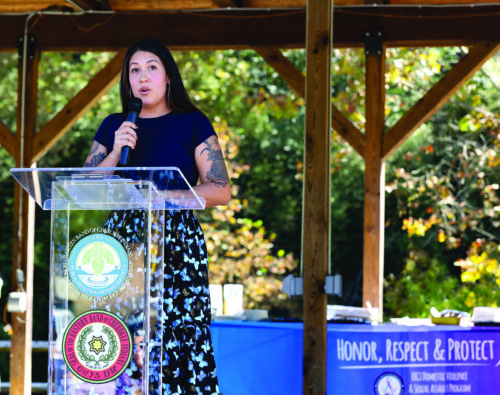
Maggie Jackson, a member of the Eastern Band of Cherokee Indians (EBCI) and co-chair of the Qualla Boundary MMIW grassroots organization, speaks at a Purple Lotus Day event at the Cherokee Welcome Center in Cherokee, N.C. on the afternoon of Thursday, Oct. 15. The event, presented by the EBCI Domestic Violence & Sexual Assault Program, featured speeches and information on domestic violence and MMIP (Missing and Murdered Indigenous People) in recognition of October being Domestic Violence Awareness Month. (SCOTT MCKIE B.P./One Feather photos)
“Domestic violence thrives in the dark,” Billie Jo Rich, EBCI Domestic Violence & Sexual Assault Program manager, said as she opened Thursday’s event. “Domestic violence lies to victims, telling them that they are alone, that it’s their fault, and that things will never change. But, today we are here to bring those lies into the light and replace them with a single, powerful truth – you are a survivor and there is hope.
Healing is not a straight line. There will be days when the past feels overwhelmingly big and loud. But, please remember that you are no longer trapped in that storm. You are now walking toward a brighter horizon. Every single step you take away from abuse, no matter how small or shaky, is an enormous victory. You are not defined by the hands that hurt you. You are defined by the resilient heart that kept beating through it all.”
Rich added, “Keep holding on. Keep reaching out. And never forget how incredibly strong you are. Just like the purple lotus flower, you, too, can rise from the darkness into the light.”
Information from the EBCI Domestic Violence & Sexual Assault Program states, “Domestic violence is a pattern of coercive behavior that is used by a person against family, household members or dating partners to gain power or control over the other party in a dating relationship. These behaviors may include: Emotional abuse, physical violence, sexual abuse, psychological intimidation, verbal abuse and threats, and stalking.”
DeMakus Staton, executive director of the non-profit organization Reflection of Inspiration, commented, “Healing looks different for everyone. What matters is knowing that healing is possible and that you do not walk alone in this journey. There are people in this community who care about you, believe you, and support you. Your voice matters. Your experience matters. Most importantly, you all matter.”
According to a report from the National Institute of Justice entitled “Violence Against American Indian and Alaska Native Women and Men”:
- “84.3 percent of women and 81.6 percent of men have experienced violence in their lifetime.
- Women have experience significantly higher levels of sexual violence (56.1 percent versus 27.5 percent for men) and stalking (48.8 percent versus 18.6 percent for men.
- 5 percent of women and 43.2 percent of men have experienced physical violence by an intimate partner.
- 4 percent of women and 73.0 percent of men have experienced psychological aggression by an intimate partner.
- Although the exact number of victimizations per person is unknown, it is clear that most American Indian and Alaska Native victims have experienced at least one act of violence committed by an interracial perpetrator (97 percent of women and 90 percent of men). Fewer victims (35 percent of women and 33 percent of men) have experienced one or more act of violence by an American Indian or Alaska Native perpetrator.”
Keahana Lambert, chief executive officer of Resilient Roots Counseling, said, “You are not alone. You are not broken. And what happened to you does not define who you are.
The symbol of the lotus is so meaningful because it doesn’t grow in perfect conditions. It grows through the muddy water. It grows through the darkness. And, it pushes its way toward the light. Many of us understand what that feels like. We’ve had to grow through things we never should have experienced. We’ve carried pain. We’ve carried grief. We’ve carried fear. We’ve carried shame that never belonged to us.”
Sheyashe Littledave, EBCI Office of the Principal Chief public relations officer, runs a MMIP podcast with Ahli-sha Stephens entitled “We Are Resilient”.
Littledave told the crowd on Thursday, “When we talk about resilience, we often focus on the experience itself. We talk about what someone endured, what they overcame, how they escaped. But, I think we forget about what happens to survivors after they break free. Because leaving doesn’t mean the fear automatically leaves with you. It doesn’t mean the damage disappears. It doesn’t mean you wake up the next morning and suddenly recognize yourself again. Sometimes, the hardest part is learning how to live when you’re no longer just trying to survive. And, that’s what resilience means to me now. Resilience is starting over. Resilience is getting up every morning, taking care of your babies, and making sure they know just how deeply loved they are.
 I stand here as a survivor, as a mother, as a sister, as a woman who found her voice again. And I get to use that voice to tell stories that matter.”
Littledave went on to say, “We have to talk about domestic violence, even when it makes people uncomfortable. We have to stop treating it like something that should stay behind closed doors. We have to stop making survivors feel ashamed of what someone else chose to do to them because that shame belongs to the abuser – not the person who stayed, not the person who was afraid, not the person who went back, not the person who needed more time.”
Brooklyn Brown Bigmeat, One Feather reporter, is a strong advocate for MMIP awareness and has produced numerous articles and graphics on the topic. “As I worked with the families on these articles, I began to notice patterns of harm including domestic violence and sexual assault.
The brighter of a light we shine on domestic violence and sexual assault the less of a chance perpetrators have of continuing to harm.”
Bigmeat added, “The One Feather is a platform for your voice. We serve the community. This is your paper, and I want to offer the paper as a platform to share your story. Your story is our hope for a safer community, and I thank you for your bravery in sharing it.”
Maggie Jackson, co-chair of the Qualla Boundary MMIW grassroots organization, stated, “We have to be willing to talk about domestic violence, recognize it, stand beside those who are experiencing it, and be brave enough to fight against it.
This crisis exists right here in our own community. Despite all our efforts to prevent domestic violence, raise awareness, and support those experiencing it, we continue to see our relatives harmed and our families impacted. That tells us that our work is not finished. Protecting our relatives from violence is a responsibility that belongs to us all.”
Anita Lossiah, EBCI director of Human Services, commented, “I wear purple today to encourage continued education and continued advocacy around the prevention of domestic violence and sexual assault. And, to encourage all to continue to empower others and empower yourself.”
Aniwodihi (Painttown) Rep. Shannon Swimmer said, “Domestic violence can happen to anyone. When a lot of people hear my story, they may be surprised that I went through that. To me, it just goes to show that it’s not something that happens overnight. It’s a process. You’re basically groomed and you’re broken down to the point where your self-esteem suffers, you feel like maybe you’re to blame or you’re at fault.
I’m still in therapy, and will be, because I think it’s important to look at our mental health the same way that we look at our physical health. You have to take care of your body. You also need to take care of your mind.”
Jill Lossiah, who works as a compliance officer in the EBCI Health Delivery Administration, commented, “As a matriarchal society, we have adopted patriarchal mannerisms where men are upheld over women and women are to obey and abide by our men, husbands, and partners. But, women have their own minds, bodies, and souls. Women are nurturers and caretakers and historically took care of the household. Relationships are supposed to build each other up and improve each other.”
Following is some contact information:
- Emergency – 911
- Cherokee Indian Police Dispatch – (828) 497-4131
- Domestic Violence and Sexual Assault Hotline (24/7) – (828) 359-6830
- https://phhs.ebci-nsn.gov/domestic-violence/