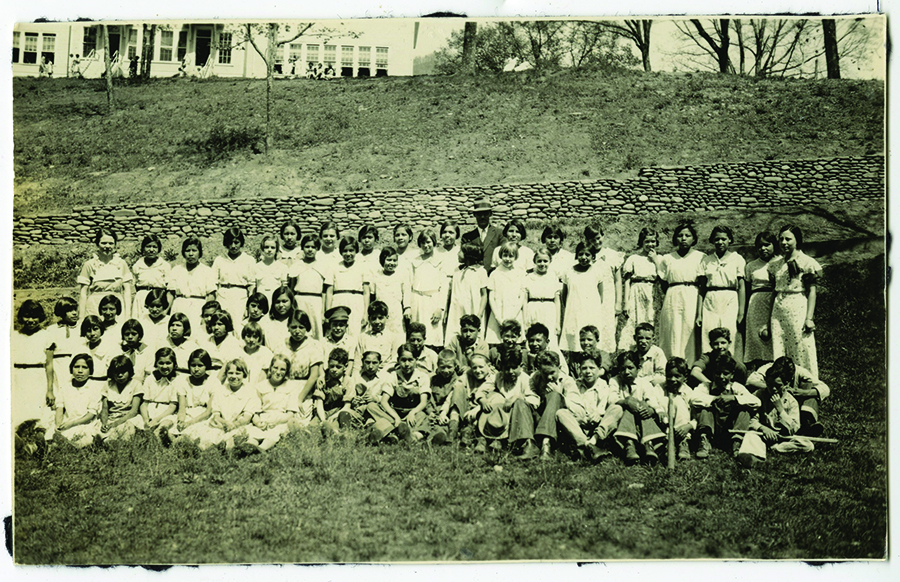
Information from the Museum of the Cherokee People states, “Photograph from the Cherokee Indian School (Cherokee Boarding School). EBCI students (including girls and boys) standing and sitting in front of a rock wall (built by Cherokee Boarding School students on the school campus). The rock wall in the background of the photo still exists as of 2026 and is the site of the EBCI PHHS Building today. This photo was likely taken around 1933.” (Collection of the Museum of the Cherokee People, 1989.006.001.13)
By SCOTT MCKIE B.P.
One Feather Asst. Editor
CHEROKEE, N.C. – Several hundred people turned out, wearing orange shirts, to commemorate the National Day for Truth & Reconciliation event hosted by the Eastern Band of Cherokee Indians (EBCI) in Cherokee, N.C. on the morning of Tuesday, Sept. 30. The event, also known as Orange Shirt Day, featured a walk and informative speeches on the subject of Indian Boarding Schools, specifically the Cherokee Boarding School.
Orange Shirt Day originated in Canada, and according to its official governmental website, “The day honours the children who never returned home and survivors of residential schools, as well as their families and communities. Public commemoration of the tragic and painful history and ongoing impacts of residential schools is a vital component of the reconciliation process.”
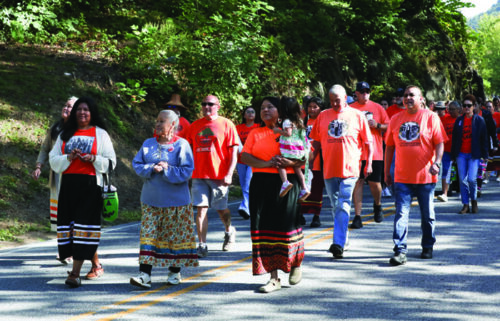
Several hundred people came out as the Eastern Band of Cherokee Indians held its 2nd Annual Every Child Matters Walk as part of the National Day of Truth and Reconciliation in Cherokee, N.C., on the morning of Wednesday, Sept. 30. The walk was in recognition of the history of Indian boarding schools, particularly the Cherokee Boarding School. (SCOTT MCKIE B.P./One Feather photo)
Renissa McLaughlin, an EBCI tribal member who serves as the EBCI director of youth and adult education, served as emcee for the event.
“What we, the organizers and committee members of this event, hope is that our community walks away today with a feeling of connection to our ancestors who attended boarding and day schools here and across the United States. Today is not just about somber remembrance. It is a gentle reminder of our role and duty as Cherokee people to educate ourselves about our shared history.
The experiences of our ancestors who attended this and other boarding schools were mixed. Some children left and never returned, or irrevocably harmed, while others found a foundation of education, agriculture, and preparation for military service. All these truths belong to our history and deserve to be remembered, honored, and shared with future generations. This is why today matters. So that when we gather on the same ground next week for the fair, we carry the full story of this place with us – not only its grief and trauma, but it’s resilience.”
McLaughlin added, “Although we still feel the impacts of historical grief and trauma, and our history, we should remember how resilient and strong we are.”
The Cherokee Boarding School operated from 1880 to 1954.
According to an informational kiosk at the event, “From 1892-1933, the Cherokee Boarding School structure followed a militaristic model. Students wore military style uniforms on certain occasions, marched to military style drills between classes, performed manual labor, and were harshly punished for not meeting certain standards or disobeying the rules. The military education model is reflected across most boarding schools nationwide, as seen in Carlisle Industrial training school in Pennsylvania and the Chilocco Indian Industrial School, for example.”
Ugvwiyuhi (Principal Chief) Michell Hicks was on official tribal business and couldn’t attend Wednesday’s event, but he pre-recorded a video message which was played.
In it, he stated, “Today we join tribal nations across North America in recognizing Orange Shirt Day and remembering the children who were taken from their families and sent to boarding schools. This is a somber day for Native people. We remember the children who never returned home. We honor those who survived. And we recognize the families and generations who have lived with the effects of what happened in those institutions.
But, remembrance also requires understanding. We have a responsibility to learn about this history – not only what happened, but what it meant for our Native families, our languages, our cultures, and our communities. Because, when we understand what previous generations endured, we better understand the strength and determination it took for our people to remain who we are…first listen, learn, and never lose sight of where we have been as we decide where we are going.”
His message continued, “This history is not as distant from us as sometimes we think. The effects of the boarding school era did not disappear when those schools closed their doors. When you deliberately separate children from their families, their language, their culture, and their community, there are consequences. That trauma is something families and communities have struggled with for generations. We still see those effects throughout Indian Country today. Understanding that history matters because it helps us better understand challenges our people faced. And, it also gives us a greater appreciation for the determination of the people who came before us, despite everything that was done to separate us from who we are. Our ancestors continued.”
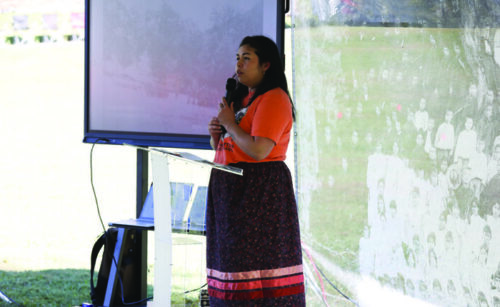
Atsei Cooper, an EBCI tribal member, speaks to the crowd during Wednesday’s event about research she has undertaken involving the Cherokee Boarding School. (SCOTT MCKIE B.P./One Feather photo)
Atsei Cooper, an EBCI tribal member, is currently a graduate student at the University of Tennessee – Knoxville studying towards a master’s degree in anthropological archaeology. She told the crowd on Wednesday of research she is conducting at the site of the Cherokee Boarding School.
“I don’t take it lightly and there’s a lot of responsibility in this. I’m grateful for the community trust and I’m glad that we can all be here because there has been so much love and hard work and dedication that has been going on behind the scenes. It really has been gadugi in the greatest sense. It’s really powerful work.”
She said a ground-penetrating radar survey is being conducted at the site. “There is a lot more work coming down the road for this. This is really only the beginning. This is really only scratching the surface with this sort of thing…this is going to be a long process. It’s delicate work and it’s got to be very informed. These are people’s hearts and lives, and we have to really treat that with the upmost care and respect.”
Cooper added, “There is an anomaly that has appeared on the survey from UNITY Field which looks very similar to a pathway where students would walk and march that you can see in historic archives and photographs…the boys here, specifically, would march twice a day and the girls would march once a day.”
She concluded, “The buildings for the boarding school may no longer be here, but if you know what you’re looking at, the ghost of the boarding school is still here all around us.”
The Cherokee Boarding School Research Initiative Committee is continuing to research and educate the public on this portion of history of the EBCI. The committee includes:
Community, Education, Recreation, and Services Division –
- Amber Ledford, Qualla Boundary Public Library cultural outreach coordinator
- Chi Shipman, QBPL manager
- Renissa McLaughlin, director of youth and adult education
Museum of the Cherokee People
- Evan Mathis, director of collections and exhibitions
- Robin Swayney, genealogist and archivist
- Lily Huskey, registrar
Cherokee One Feather
- Dawn Arneach
Public Health and Human Services
- Chelsea Hemphill, public relations supervisor
EBCI Natural Resources
- Malia Crowe-Skulski,
Office of the Principal Chief
- Driver Blythe
Atsei Cooper, community researcher and historical grief and trauma advocate
Patty Grant, EBCI tribal elder
Family members of the late Mary Wachacha – Sarah Wachacha, daughter; Judy Gloyne Tiger, sister
Ugviwyuhi Hicks also issued an official proclamation designating Sept. 30, 2026 as Orange Shirt Day on the lands of the EBCI. The proclamation reads as follows:
WHEREAS: Orange Shirt Day is observed annually on Sept. 30 as a day to remember and honor Indigenous children who were taken from their families and communities and forced into residential and boarding school systems designed to separate them from their languages, cultures, families, and identities, and
WHEREAS: Orange Shirt Day began with the story of Phyllis Webstad, whose new orange shirt was taken from her on her first day at a residential school, and whose experience has become a powerful symbol of the harm inflicted upon generations of Indigenous children, and
WHEREAS: For generations, Indigenous children across the United States were removed from their homes and sent to government-operated and church-run boarding schools where many experienced the loss of language and culture, separation from family and community, abuse, neglect, and, in far too many cases, death, and
WHEREAS: Cherokee children and families were also affected by policies intended to assimilate and disrupt the transmission of Cherokee language, traditions, identity, and ways of life from one generation to the next, and
WHEREAS: The lasting effects of these policies continue to be felt within Cherokee families and communities today, making truth, remembrance, education, cultural revitalization, and healing essential to the well-being of future generations, and
WHEREAS: The message of Orange Shirt Day reminds us that every Indigenous child deserved then, and deserves now, to be safe, loved, valued, and connected to their family, culture, and identity, and
WHEREAS: The Eastern Band of Cherokee Indians honors the children who endured the boarding school era, remembers those who never returned home, recognizes the strength of survivors and their descendants, and remains committed to protecting Cherokee children, families, language, culture, and community for generations to come
Now, therefore, I, Michell Hicks, Principal Chief of the Eastern Band of Cherokee Indians, do hereby proclaim Sept. 30, 2026, as Orange Shirt Day within the Qualla Boundary and encourage our community to wear orange in remembrance of the children who were taken, in honor of the survivors and families whose lives were forever changed, and as a visible commitment to ensuring that every child matters.