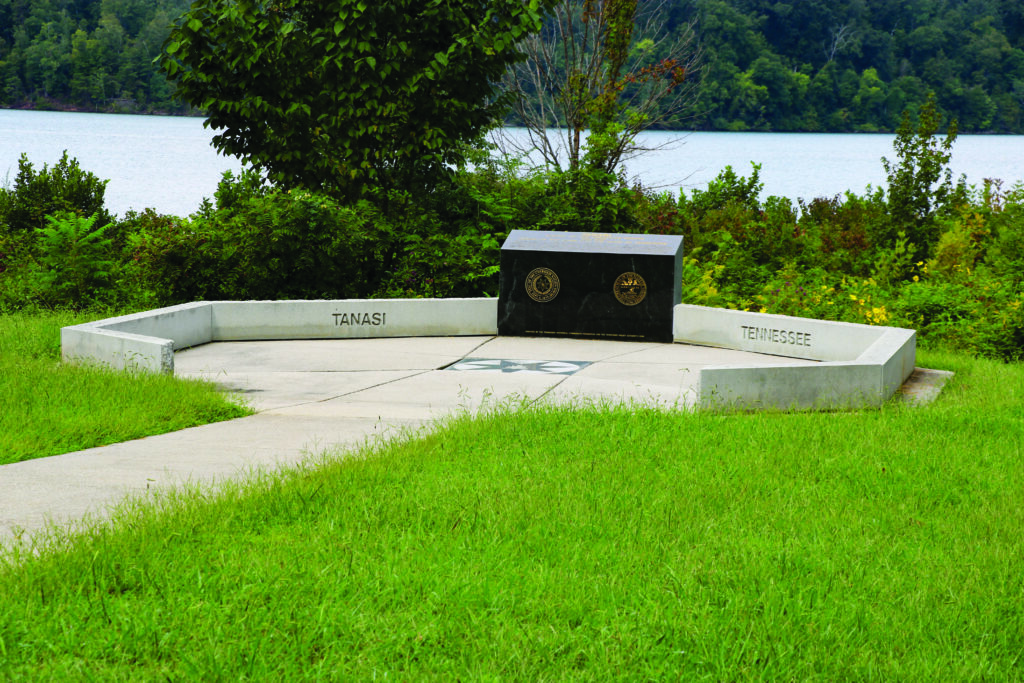
A bill that would place 76 acres of land containing several historic sites, such as the Tanasi Memorial (shown above), in eastern Tennessee in trust for the Eastern Band of Cherokee Indians (EBCI) was discussed in a hearing in the Senate Committee on Indian Affairs on Wednesday, Sept. 23. (SCOTT MCKIE B.P./One Feather photos)
By SCOTT MCKIE B.P.
One Feather Asst. Editor
WASHINGTON, DC – A bill (H.R. 226) that would place 76 acres of land, containing several Cherokee historic sites in eastern Tennessee, in trust for the Eastern Band of Cherokee Indians (EBCI) was discussed in a hearing in the Senate Committee on Indian Affairs on Wednesday, Sept. 23.
H.R. 226 (Eastern Band of Cherokee Historic Lands Reacquisition Act) was introduced into the 119th Congress on Jan. 7, 2025 by Congressman Charles J. “Chuck” Fleishmann (R-Tenn.). It passed the House in a voice vote on Feb. 5, 2025 marking the fifth Congress in a row that the legislation has passed in the House.
According to language in the bill, the 76 acres includes approximately 46 acres at the site of the Sequoyah Birthplace Museum, around 18.2 acres which includes the Chota Memorial and the Tanasi Memorial, and another 11.2 acres known as “support parcel”. Also included in the bill are permanent easements for the Chota Peninsula, which includes 8.5 acres, and the Chota-Tanasi Trail which has 11.4 acres.
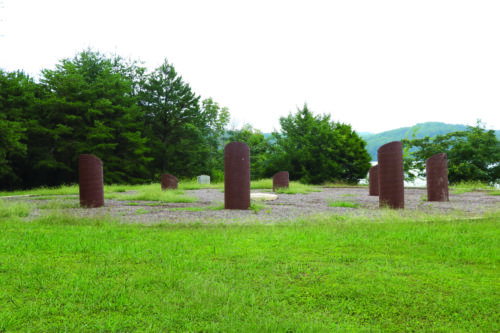
The Chota site is shown in this photo.
Opening discussion on the bill during Wednesday’s hearing, Bryan Mercier, Bureau of Indian Affairs director and a member of the Confederated Tribes of Grande Ronde, voiced his support for the legislation, “The Department supports H.R. 226. Returning ancestral and historic lands to tribal stewardship honors the enduring legacy and sacred traditions of the Eastern Band of Cherokee Indians. The Department has coordinated closely with the TVA and notes that the bill appropriately preserves TVA flowage and flood-control easements while ensuring continued public access to memorial facilities. The Department stands ready to execute the administrative trust conveyance upon enactment.”
EBCI Ugvwiyuhi (Principal Chief) Michell Hicks gave testimony on the bill during the hearing. “The lands we ask Congress to return are a small part of our ancestral homelands. They include Chota, once the political and cultural heart of the Cherokee people; Tanasi, which gave the State of Tennessee its name; and the birthplace of Sequoyah, who single-handedly created the Cherokee syllabary, our written language. These places are part of who we are and that connection endured through the forced removal of thousands of Cherokee people from our homelands in the 1830s where one-third of our people perished.
In 1967, the TVA began construction of the Tellico Dam on the Little Tennessee River. The project would create a reservoir stretching more than 30 miles through the Little Tennessee River Valley including historic Cherokee town sites of Chota and Tanasi, and lands connected to Sequoyah’s birthplace. Our people opposed the project and warned that it would harm burial places, medicinal plants and areas, and cultural and historical places throughout the valley. Despite those efforts, the project moved forward and, in 1979, the Tellico Dam was completed and the reservoir flooded portions of our ancestral homelands. Of course, the damage was permanent. Places our ancestors had known for generations were changed forever.”
He went on to state, “In the years that followed, the Eastern Band continued working to protect these places and maintain our connection to them. We work with the TVA. We invested in the Sequoyah Birthplace Museum, which has served as an educational resource in Tennessee since 1986. We care for these historic places and continue telling their story. Since the mid-1908s, the Eastern Band has managed most of the properties included in this legislation through permanent easements granted by the TVA.
We do not measure the importance of these places in acres. We measure it in generations. Generations fought to protect these places, and generations of our people have worked to get them back. When our children visit Chota, Tanasi, or the birthplace of Sequoyah, I personally do not want them to see places only as somewhere Cherokees used to be. I want them to understand that they are standing on Cherokee land, and there is a difference.”
Ugvwiyuhi Hicks concluded by stating, “This Congress cannot change what happened to our people. It cannot undo the damage, and it cannot put back what was flooded by Tellico Dam. But, this Congress can do something meaningful today. It can return these lands to our tribe. And, when these lands are returned, we will fulfill the responsibility that comes with this land.”
Sen. Lisa Murkowski (R-Alaska), chairwoman of the Senate Committee on Indian Affairs, addressed Ugvwiyuhi Hicks following his statement. “I know you are truly looking forward to getting this over the finish line.
What is this going to mean to you and to the Tribe once this is complete?…What is the significance of finally resolving this after decades of pushing to advance it?”
Ugvwiyuhi Hicks responded, “If you just think about a piece of fabric and you think about the spiritual aspect of the fabric. You think about the graves. You think about the cultural sites as you’ve heard today. And, a piece of that fabric has been missing for decades. That’s what it means to us. We’re starting to regain, especially these areas that mean so much to our tribe. And, as a tribal member, as an elder of the tribe now, to know that we can bring this back and our children can learn from those histories – whether good or bad – and they can go celebrate the memorials of former chiefs, they can know that in perpetuity that they can protect this former capital of our people, that’s what it means to us. In comparison to touching eight states – historically the Cherokee people did – this is a drop in a bucket. But, when you think about it from the perspective of what it means to us as a people, it’s bigger than those eight states.”
Previous bills on this issue include:
- 118th Congress – H.R. 548 (Eastern Band of Cherokee Historic Lands Reacquisition Act). This bill was introduced by Rep. Fleischmann on Jan. 26, 2023. It passed the House in a voice vote on Feb. 6, 2023. The bill died in the Senate.
- 117th Congress – H.R. 2088 (Easter Band of Cherokee Historic Lands Reacquisition Act). This bill was introduced by Rep. Fleischmann on March 19, 2021. It passed the House by a vote of 407-16 on Nov. 2, 2021. The bill died in the Senate.
- 116th Congress – H.R. 453 (Eastern Band of Cherokee Historic Lands Reacquisition Act). This bill was introduced by Rep. Fleischmann on Jan. 10, 2019. It passed the House in a voice vote on Dec. 16, 2019. The bill died in the Senate.
- 115th Congress – H.R. 146 (Eastern Band of Cherokee Historic Lands Reacquisition Act). This bill was introduced by Rep. Fleischmann on Jan. 3, 2017. It passed the House by a vote of 383-2 on April 16, 2018. The bill died in the Senate.
- 114th Congress – H.R. 3599 (Eastern Band Cherokee Historic Lands Reacquisition Act). This bill was introduced by Rep. Fleischmann on Sept. 24, 2015. A meeting was held in the House Natural Resources Subcommittee on Indian, Insular, and Alaska Native Affairs on Feb. 24, 2016, but a vote never occurred in the House.
According to H.R. 226, “No Class II or Class III gaming, as defined in the Indian Gaming Regulatory Act, shall be conducted on lands subject to this Act.”