By BROOKLYN BROWN BIGMEAT
One Feather Reporter
CHEROKEE, N.C.— The One Feather interviewed District Attorney Ashley Hornsby for Prosecutorial District 43 (Cherokee, Clay, Graham, Haywood, Jackson, Macon, and Swain Co.) as part of an ongoing criminal justice reporting project supported by the International Women’s Media Foundation’s Fund for Indigenous Journalists: Reporting on Missing and Murdered Indigenous Women, Girls, Two-Spirit and Transgender People (MMIWG2T), and the 2026-27 Law & Justice Journalism Project (LJJP) Fellowship.
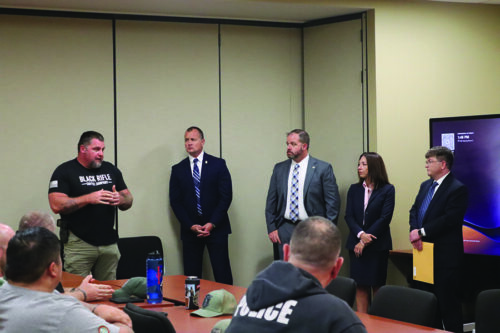
Pictured fourth from left, Ashley Hornsby visits Cherokee Indian Police Department (CIPD) Oct. 1, 2025, with the North Carolina State Bureau of Investigation to present CIPD with awards in excellence. (BROOKLYN BROWN BIGMEAT/One Feather photo)
In serving her district, Hornsby said her office works closely with Cherokee Indian Police Department (CIPD) and Cherokee Tribal Court. “We have a very strong working relationship with both the Cherokee Indian Police Department and the Tribal Courts. Our goal is always to work together to ensure justice. Communication is the key with both CIPD and the Tribal Prosecutor’s Office.”
State jurisdiction on the Qualla Boundary must involve non-Indian perpetrators and victim(s). Tribal jurisdiction involves either an Indian perpetrator and/or victim in Indian Country. Crimes involving a non-Indian perpetrator and victim in Indian Country do not follow under tribal jurisdiction, unless included in the Violence Against Women Act (VAWA), which is a federal law that provides for protections for victims of domestic and dating violence, sexual assault, and stalking.
Those crimes not protected under VAWA involving a non-Indian perpetrator and victim fall to the state. Federal jurisdiction must involve an Indian perpetrator and/or victim in Indian Country, and must be a major crime, or a crime included under VAWA.
Hornsby explained specifically how her office, which is the state’s office, gets involved with cases from the Qualla Boundary. “The most populated portions of EBCI Tribal Territory in the 43rd Prosecutorial District are in Swain and Jackson Counties, and the [Assistant District Attorneys (ADAs)] and support staff assigned to those offices work on cases charged in and/or connected to the Qualla Boundary. Our ADAs in Jackson and Swain counties are available for questions from EBCI law enforcement—both CIPD and [Alcohol Law Enforcement (ALE)]—24/7. There are two primary ways that a crime occurring on the Qualla Boundary comes to our office. The first and most frequent way is when an officer initiates a charge by a warrant by going before a magistrate in the county in which the charge is being brought. All EBCI law enforcement are able to take out charges directly in State Court by warrant just as officers who are employed with agencies off Boundary. These cases all begin in District Court, although many felony cases are later indicted by the Grand Jury and then proceed in Superior Court. The other way in which a case comes to our office is when an officer makes us aware of an investigation—or the need for an investigation. We advise and assist through the course of the investigation and work closely with the officer(s) to determine what crimes are appropriate to charge.”
Hornsby added, “My office is staffed with attorneys and support staff who have experience in and connection to the Qualla Boundary. In Swain and Jackson counties in particular, I have Assistant District Attorneys with considerable experience practicing in the Cherokee Court. Not only do we have an excellent working relationship with law enforcement in Cherokee, but we also have excellent relationships with other Tribal agencies and organizations.”
The One Feather is following several Qualla Boundary cases associated with Hornsby’s office, and we will continue to provide updates on those cases to illuminate court processes in Indian Country.