By BROOKLYN BROWN BIGMEAT
One Feather Reporter
CHEROKEE, N.C. – Teachers and staff from the Cherokee Language Master Apprentice Program (CLMAP) have been working through the summer to consolidate resources and update their curriculum. The curriculum team includes CLMAP Teacher Aaliyah “Aliyo” Swimmer, CLMAP Teacher Dylan “Dalala” Lossiah, CLMAP Teacher and Adult Language Educator Scarlett “Gigage” Guy, Curriculum Instruction Coordinator Taylor “Talutsa” Wilnoty, and Speaker Services Supervisor Brittany “Tsisgwa” Frady.
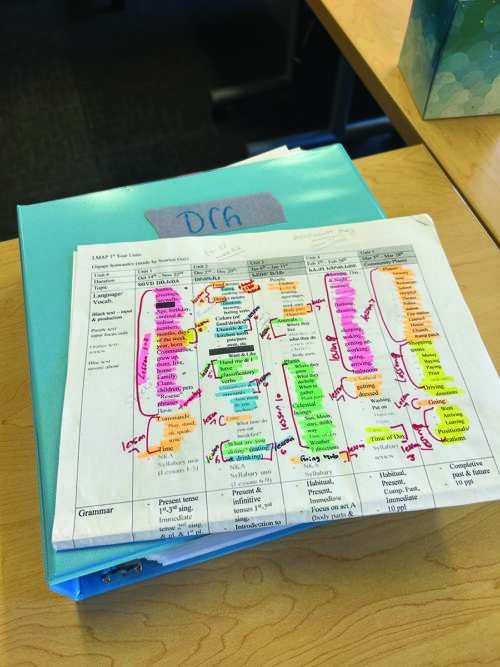
CLMAP Teacher Aaliyah “Aliyo” Swimmer’s first-year cohort binder. (BROOKLYN BROWN BIGMEAT/One Feather photo)
After holding a curriculum development workshop earlier this summer with language program experts from the Cherokee Nation and Awkesasne Mohawk Nation, the team is sharing a newly developed curriculum for the CLMAP first, second, and third-year program cohort. Much of the work has consisted of consolidating resources from Microsoft SharePoint folders and Kituwah Preservation Education Program (KPEP) teaching materials. Gigage said the team is working from pre-existing materials, including her and Aliyo’s lesson plans. Aliyo has combined materials from Gigage’s lesson planning and her own to create an entire first-year cohort binder.
Tsisgwa, who previously worked as a teacher at New Kituwah Academy (NKA), said a curriculum is different from a lesson plan. The curriculum is a guideline for lesson planning that includes Cherokee Core Values, unit mapping, and proficiency standards.
The curriculum includes unit mapping for the first, second, and third year of the program, each with 18 units divided into 4 quarters. The third year is a teacher apprenticeship: Quarter 1 is observation in the classroom, Quarter 2 is co-teaching, Quarter 3 is solo teaching, and Quarter 4 is a capstone project.
After applying some finishing touches, the team hopes to share the curriculum publicly via an online link on the KPEP website, which they are also updating, by October. The next CLMAP cohort will operate under the curriculum. The team said they are open to feedback and critique to implement the best learning guidelines for the program.
Gigage shared some statistics from the program’s inception in 2018 to now. “To the best of my knowledge in consultation with Aliyo and Chi Shipman, there have been a total of 33 CLMAP/(CALL) graduates since the first graduation in 2020. The first cohort was brought on in 2018 and started as a 24-32 hours per week contracted position program. In the fall/winter of 2022, Tribal Council turned the apprentice positions in the program into full-time 40 hours per week tribal employee positions. Teachers were still contract employees until early 2025.
Since 2020, there have been 6 cohorts to graduate from the 2-year program. A new cohort wasn’t allowed to be brought on in 2020 due to the COVID-19 pandemic, so there was no graduating class two years later in 2022. The breakdown is as follows:
2020 – 3 graduates
2021 – 4 graduates
2022 – 0 graduates
2023 – 3 graduates
2024 – 7 graduates
2025 – 8 graduates
2026 – 8 two-year graduates & 1 third-year graduate.”
Of the 2026 two-year graduates, five are continuing in the third year of the program. The other three are working in the language: Dalala is a CLMAP teacher, Steven “Galagina” Long is an NKA teacher, and Gabby “Adahosgi” Thompson is the NKA media coordinator.
The One Feather will share an accessible link to the curriculum once it goes live.