By ANN TOINEETA
One Feather Intern
CHEROKEE, N.C. – The Way We See The World, presented by the Museum of the Cherokee People, is back for its fifth year and will be held on Friday, Aug. 7 in the Council Fire Ballroom at Harrah’s Cherokee Casino Resort from 5 p.m. to 8:30 p.m. This event “is a free, community-centered event spotlighting Indigenous self-representation in the current media and cultural landscape,” according to the museum’s description. Free tickets can be reserved via Eventbrite.
Information per the organizers states, “2026’s event invites audiences to be inspired and laugh out loud with two moving short documentaries, a short romantic comedy, a live DJ set, silent auction, 50/50 raffle, and art market.”
The following films will be featured:
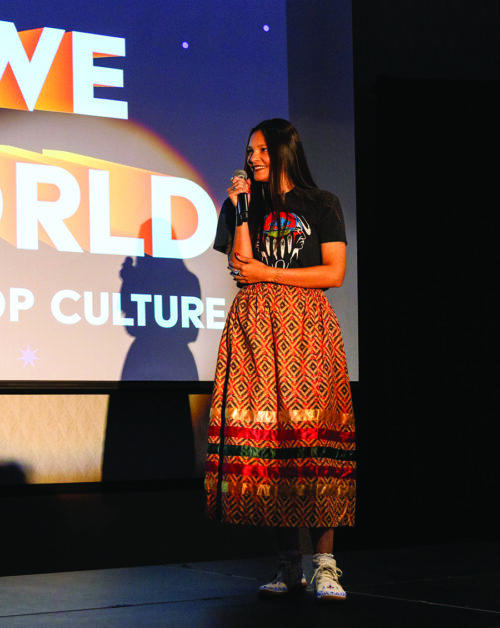
Loren Waters, a Cherokee Nation citizen, is shown introducing her film, “Tiger”, at the 2025 The Way We See the World event presented by the Museum of the Cherokee People. (Photo courtesy of the Museum of the Cherokee People)
“Ahyoka” (2026), directed by Schon Duncan (United Keetoowah Band of Cherokee Indians), “is a portrait of Ahyoka Youngdeer, Cherokee culture bearer, teacher, and two-spirit activist. Through her own life story, woven together with a traditional Cherokee story about crooked-faced children left in the woods and their return to community, Ahyoka traces how exclusion from school, family, and her own people, was never written into Cherokee values. It was imported. An elder’s story reveals what was always true: she was never the problem. Through her journey, ᎠᏲᎧ reminds Cherokee people that Keetoowah is a lifeway. And we must live it.”
“Women of the Stony Shore: Shinnecock Kelp Farmers” (2026), directed by Nathaniel Cummings-Lambert (EBCI), “follows a multigenerational coalition of Shinnecock women who use kelp farming to counter ecological damage to the waters surrounding their traditional homelands. The film documents the full arc of the growing season: seedlings cultivated in aquarium tanks each fall, transferred to anchored ocean lines in December, and harvested the following spring. Throughout the growing season, we meet the six women behind this regenerative aquaculture initiative and learn how their work draws pollutants from the bay’s waters while exercising sovereignty and reclaiming a practice rooted in centuries of Shinnecock seaweed harvesting.”
“Julie Takes A Walk” (2026), directed by Frankie Pedersen (Listuguj Mi’gmaq First Nation) and Shea Vassar (Cherokee Nation), is a romantic comedy. The film’s logline reads, “When Julie shows up disheveled to a dive bar in the middle of nowhere, her connection with the bartender is a nice surprise.”
Additionally, there will be a sneak peak of Anthony Sneed’s (EBCI) new film, “Bastards of the Boundary: The Little Brother of War.”
There will be a comedy set by Zebediah Nofire (Cherokee Nation), who was recently added to the lineup.
The art market will feature works by the following EBCI artists: Katt Neff, Cleto Montelongo, Alica Wildcatt, Mona Taylor, Jakeli Swimmer, Amy Postoak, and Freida Saylor.
Shana Bushyhead Condill, who has been the executive director of the Museum of the Cherokee People since 2021, explained the purpose and meaning of The Way We See The World. She said that the event is an opportunity for Native American artists to represent themselves and their perspectives.
“It was sort of a moment to take a second and think about what we do as a museum and what our role is,” she said about the creation of the event. “What really came to the forefront for us was the importance of Native self-representation. It was important to really make that distinction about Native people representing ourselves instead of other people having representations about us.”
The Way We See The World offers a platform that allows Native artists to be seen and fights against the inaccurate depictions of Native Americans that have dominated traditional media.
“We’ve seen the statistics for what misrepresentations of Native people can do for Native youth. It’s not good, it’s harmful,” Condill said. “Shining a light, putting more Native-made projects out front, I think is really powerful, impactful, and shows our community it’s possible. We have a lot of talent in our community and in Indian country in general.”
The goal of The Way We See The World is to inspire Indigenous people to use their voices and let audiences know that Indigenous art and expression doesn’t have to look one way.
“We as Native people have a voice today and that is what this event represents,” Condill said. “You don’t have to only be in historic images that people have of us. A lot of people want to keep us in the past, so showing them what it looks like to be a Cherokee person in 2026 is so important.”