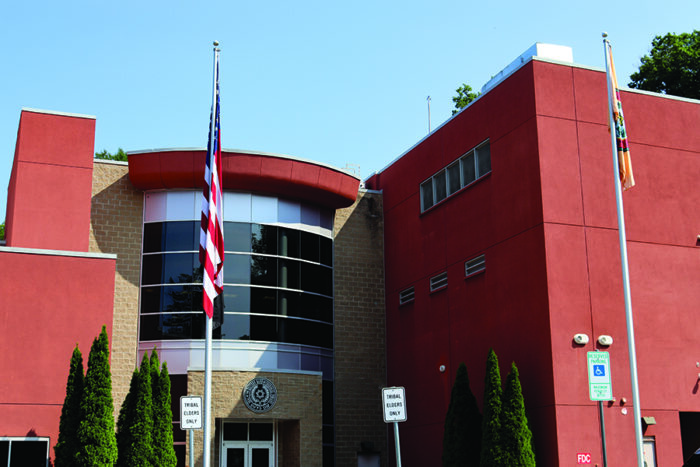
The flags of the Eastern Band of Cherokee Indians, right, and the United States, fly at the Anthony Edward Lossiah Justice Center in Cherokee, N.C. on Thursday, June 25. (BROOKLYN BROWN BIGMEAT/One Feather photo)
By BROOKLYN BROWN BIGMEAT
One Feather Reporter
CHEROKEE, N.C. – The One Feather sat down with Cherokee Indian Police Department (CIPD) Attorney Cody White to discuss crime and case jurisdiction on the Qualla Boundary as part of an ongoing criminal justice reporting project supported by the International Women’s Media Foundation’s Fund for Indigenous Journalists: Reporting on Missing and Murdered Indigenous Women, Girls, Two-Spirit and Transgender People (MMIWG2T), and the 2026-27 Law & Justice Journalism Project (LJJP) Fellowship.
White said tribal jurisdiction involves either an “Indian perpetrator and/or victim in Indian Country.” Crimes involving a non-Indian perpetrator and victim in Indian Country do not follow under tribal jurisdiction, unless included in the Violence Against Women Act (VAWA), which is a federal law that provides for protections for victims of domestic and dating violence, sexual assault, and stalking.
Those crimes not protected under VAWA involving a non-Indian perpetrator and victim fall to the state. Federal jurisdiction must involve an “Indian perpetrator and/or victim in Indian Country,” and must be a major crime, or a crime included under VAWA.
White noted, “I use the term ‘Indian’ because that is the legal definition that is given by the United States code. An Indian has to be involved, and the crime had to occur in ‘Indian Country,’ and that is also defined in federal law…Aside from that, if [tribes] don’t have jurisdiction, then it goes to state court. So, it’s not a free pass. Someone doesn’t get a free pass, it’s just about where we take them, and whether or not it fits in this box, this box, or this box, and sometimes it fits in both.”
White added that just because there may be federal jurisdiction in a case, that does not mean the case will be picked up federally.
“Just because the federal court has jurisdiction, they are a court of discretionary jurisdiction. So, they don’t have to take the case. They may have the ability and the authority to, but they can choose not to. Sometimes that happens. And for better or worse, some people complain about it, but I see it as an opportunity for sovereignty. It’s like, ‘Well, we’re acknowledging that [tribes] can handle it.’”
White said in recent years, it is not often that federal prosecution does not pursue a case under their jurisdiction on the Qualla Boundary. “The assistant United States attorney assigned to us is Alex Scott and he has done a fantastic job of picking up cases. Recently, they’ve picked up a lot. They’ve picked up almost all of our current pending homicides.”
The One Feather plans to follow several court cases for crimes occurring on the Qualla Boundary that are pending in tribal, state, and federal court to detail the various court processes.