By SCOTT MCKIE B.P.
One Feather Asst. Editor
CHEROKEE, N.C. – Members of the Eastern Band of Cherokee Indians (EBCI) wore red to remember relatives taken too soon and bring awareness for those currently missing. The 7th Annual Missing and Murdered Indigenous Relatives Walk, hosted by the Qualla Boundary MMIW (QBMMIW) Organization, was held at the Oconaluftee Island Park on the afternoon of Saturday, May 2.
Maggie Jackson, co-organizer of the event and a leader of QBMMIW, commented, “This event is powerful because at QBMMIW we believe that centering families and coming together as a community is essential. When families are honored and held with care, remembrance becomes healing and awareness becomes a responsibility.
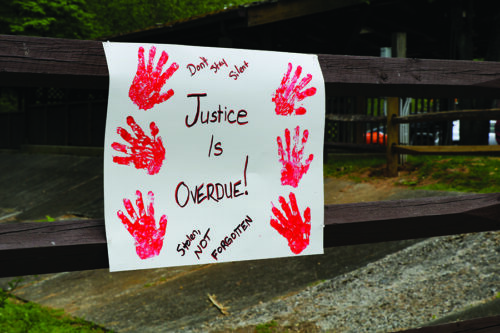
The 7th Annual Missing and Murdered Indigenous Relatives Walk, hosted by the Qualla Boundary MMIW Organization, was held at the Oconaluftee Island Park on the afternoon of Saturday, May 2. The media was asked to refrain from taking photographs of participants and the One Feather honored that request and only took photos of signs. (SCOTT MCKIE B.P./One Feather photos)
Here, on the Qualla Boundary, there are 66 known and documented cases of missing or murdered Indigenous relatives. Those are not statistics. They are lives. They represent children, parents, siblings, and loved ones whose absence is still felt every single day.”
She added, “We can protect our people by believing families, by honoring lives with dignity, by refusing silence, and by working together to create safety, accountability, and care.”
EBCI Ugvwiyuhi (Principal Chief) Michell Hicks said, “It’s never easy preparing these words because of the sadness, and the grief, and, truly, the unanswered questions that a lot of our families continue to hold.
We have to lean on each other. We have to know that a community is behind you, families are behind you…there’s nothing easy about these circumstances.”
Anna Ferguson, an EBCI tribal member who serves as the representative of the 119th District in the N.C. House of Representatives, noted, “I’m also sad because when we lose our loved ones, we carry that grief not only personally, but we carry it together. But, I’m also angry. I’m mad because we still have to have an event, and we still have to have a walk, and we still have to stomp our feet and say, ‘when our people go missing, it matters. It matters just as much’.
I look forward to the day when we don’t have to have events to tell people that we matter and that our missing people hurt just as much as anyone else.”
Following are some statistics, from the National Congress of American Indians (NCAI), on violence against American Indian/Alaska Native (AI/AN) women:
- More than 4 in 5 (84.3 percent) have experienced violence in their lifetime.
- More than half (56.1 percent) have experienced sexual violence in their lifetime.
- More than half (55.5 percent) have experienced physical violence by intimate partners in their lifetime.
- Almost half (48.8 percent) have been stalked in their lifetime.
- The murder rate of AI/AN women is almost three times that of non-Hispanic white women.
The National Indigenous Women’s Resource Center (NIWRC) states, “Homicide is roughly the third leading cause of death among Indigenous women ages 10-24.”
Information from NIWRC continues, “95 percent of cases identified by the Urban Indian Health Institute had not been covered by the mainstream media. Because of limited data, there is no reliable nationwide count of how many Native women go missing or are murdered each year.”
Information from the Bureau of Indian Affairs states, “According to the Centers for Disease Control and Prevention’s National Vital Statistics System, homicide was the fourth leading cause of death among 1-44 year old American Indian/Alaska Native (AI/AN) males and the sixth leading cause of death among 1-44 year old AI/AN females in 2023.”
Elawodi (Yellowhill) Rep. Shennelle Feather commented, “I have so much respect for everyone who is here and who is grieving and who is desiring answers and may not ever get them. I hold you all, each of you, in my prayers, in my heart every single day.
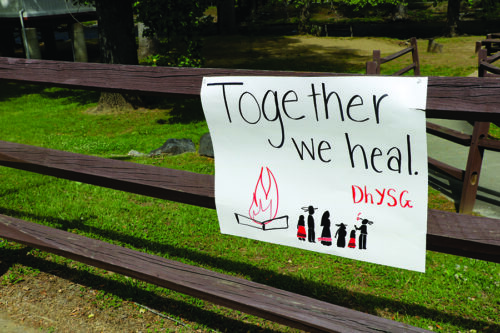 I think that’s important to acknowledge that we are one, we are all here together, and we feel the loss together. That is not any different than other Indigenous communities.”
Rep. Feather went on to state, “This collective nervous system, this community, we all feel loss. We all feel grief. No one is more valuable than the other.
We all feel a void. We all feel that loss. If we can come together and continue to just hold each other up, like the river cane do. When you see it grow, they don’t grow by themselves. They have to grow in a bunch because they hold each other up. And, that’s what we have to continue to do and continue to reflect.”
Kolanvyi (Big Cove) Rep. Venita Wolfe said, “I look around and I see so many beautiful people with great hearts. And, having to be here today is sad. It makes me sad to know that we lost people, and we’re still looking for them.
It also makes me happy to see us come together in one area, in one place, and know that, whatever happens, we’re here for each other. I’m here for you…Grieving is hard. And I know not having answers makes it harder.”
Carla Neadeau, Cherokee Indian Police Dept. Chief of Police, said, “Today, we stand together in recognition of strength and resilience of Indigenous relatives – strength that has carried generations forward despite the injustices that we have faced. The Cherokee Indian Police Department is working tirelessly to combat the harm that has long plagued our community. We understand that the issue of Missing and Murdered Indigenous People is not just a law enforcement matter. It is a crisis that demands attention, understanding, and action by all across Indian Country.”
She said the CIPD cannot do it alone. “It takes all of us – families, leaders, educators, and allies, to bring justice, healing, and hope. Let this be our message to Indigenous people everywhere – you are not forgotten. Your voices matter. Your lives are worthy of protection and justice. Together we stand, determined to stop the harm and to create a world where the future is bright, safe, and full of promise.”
Noland Brown is a therapist at Analanisgi at the Cherokee Indian Hospital Authority. He commented, “Experiencing grief in a Native community is different because when one of us grieves, we all grieve. We are connected through kinship and we experience loss together. That’s why events like today are so important because it’s a community to come together to grieve together. Grief is generational. We carry it in our bones and our blood. And, when we go to water, we can let our grief flow into the river and let the healing power of that water seep into our heart. We can lean on our family and our tribe who share that same grief.”
As Cherokee men, we must restore our tradition of protecting, uplifting, and valuing our women and children to break these cycles of harm. That is part of the healing that will change and give our grief meaning and revive our community.”