By BROOKLYN BROWN
One Feather Reporter
CHEROKEE, N.C. – On Wednesday, Nov. 5, the Eastern Cherokee Agency of the Bureau of Indian Affairs (BIA) ignited a prescribed fire in the Lickstone Ridge area. The next burn will be in the Dobson Ridge area.
Dave Collins, Eastern Cherokee Agency fire management officer, says the prescribed burns, conducted by fire practitioners, are a short-term inconvenience with long term benefits, “The long-term benefits for the ecosystem are going to create more biodiversity and more carrying capacity for wildlife, and that ties into tribal food sovereignty.”
Logan Blankenship, Tsalagi Fuels Module, said he is already seeing benefits from the Lickstone fire. “There were grouse up in our burn just the morning after. A big thing for me is wanting to serve the tribe and the basket makers and artisans. That’s our biggest goal is serving the tribe. We take pride in that.”
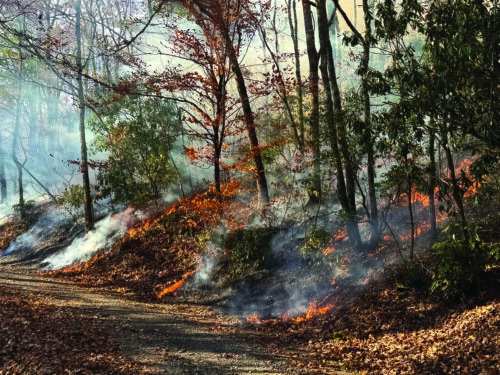
The prescribed fire on Lickstone Ridge (Photo by Evan-Marie Petit, fire prevention specialist)
Gabe McMillan, Tsalagi Fuels Module, has also witnessed benefits of the prescribed burns over the years. “The first one that we actually did here was in 2017 and I was on it. I did most of the lighting on it. Going back years later and looking at it, you can definitely see the effects that it had on the landscape,” he said.
Collins says the prescribed fires are part of a cultural burning initiative led by EBCI Natural Resources, “The EBCI Natural Resources department really is leading the charge on working to define what culturally informed prescribed fire looks like or traditional ecological knowledge that’s informed through a long process. There’s a lot of people that have a lot of info to bring to the table. My hope is that we continue on this amazing path we’re on right now where natural resources and the Bureau of Indian Affairs are working together and we’re building a really strong relationship,” he said.
“Everything that I do around planning prescribed fire is informed by them and we’re trying to listen, and because there’s many community members that work here, it’s also informed by them because these guys are the technical experts.”
Collins explained some of the science behind the benefits of the burns. “When you burn the ridges like we did, you’re opening up the forest floor, you’re unlocking the minerals and nutrients that are in that duff layer, making it more available to the plants. There’s a lot of dormant seeds that are carried under that duff layer and that wakes them up,” he said.
“You can see the increased plant biodiversity after a burn. Also, there’s a process called mesophication, which is the fire suppressing plant species that come in. Here, that’s the red maple, the poplar, the rhododendron, the mountain laurel, those are some of the big ones. They’ve been marching up the mountain due to the traditional practice of regular fire being removed. These species are making their way further and further up the mountain and competing with the young oak and hickory trees, which are the mass producers that feed the wildlife. Also, white oak is used for baskets, hickory for ball sticks, and many other uses as good hardwood. That’s what we’re trying to do is we’re trying to knock that stuff back down off the ridges and make room for the fire tolerant species that serve a better ecosystem function.”
Collins added that the prescribed fires are also preventative measures for wildfires, “The other part of why we’re burning is to reduce the hazardous fuels and help us to manage a large wildfire. If we got into an extended drought and we had a really windy day and there was a big fire romping across the boundary, those areas that we burn become holding features that make it a lot easier for us to catch those unplanned fires and try to mitigate those.”
For additional information, contact Evan-Marie Petit, fire prevention specialist at (707) 684-6544 or evan.petit@bia.gov:
“The Eastern Cherokee Agency encourages and welcomes feedback from the community. The work we do is to serve EBCI first and foremost, and we plan to create more spaces for community dialogue and collective learning going forward.”