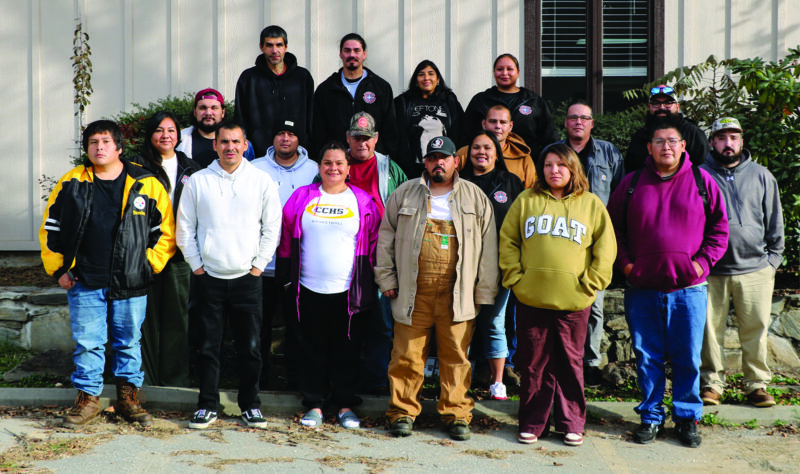
Staff and participants in the Mother Town Healing Program are shown outside of the EBCI TERO (Tribal Employment Rights Office) on the morning of Wednesday, Oct. 28. They are shown, left to right, back row – Anthony Welch (Peer Mentor), Cage Jones (Assistant Supervisor), Ana Santoyo, Callie Long (Assistant Supervisor); middle row – Shannon Bark (Supervisor) Isaiah Frady, Michael Wolfe, Thomas Ward, Alisha Toineeta (Assistant Supervisor), Austin Lambert, Jeff Thompson (Workforce Development Manager), Jacob Crowe (TERO Director), Salvador Taylor; and front row – Elicio George, Jordan Panther, Jessica Lossiah (Peer Mentor), Billy Jack Crowe, Bryton Esquivel, and Steven Thompson. (SCOTT MCKIE B.P./One Feather photo)
By SCOTT MCKIE B.P.
One Feather Asst. Editor
CHEROKEE, N.C. – The Mother Town Healing Program is helping members of the Eastern Band of Cherokee Indians (EBCI) in recovery get into the workforce and back into their community. Started in 2017, the program, which is under the EBCI TERO (Tribal Employment Rights Office), currently has 16 participants with a maximum capacity of 18.
Jeff Thompson, TERO workforce development manager, said, “The purpose of the Mother Town Healing Program is to help those in recovery regain job skills that they might have lost while they were in active addiction. And, hopefully, at the end of the program, to successfully gain a job.
We hold an interview process to get them into the program. It’s really just a short list of questions to see where they’re at within their recovery and how they might fit within the program.”
Thompson said their success rate in the program is between 85 to 90 percent. “We’re rocking and rolling. We’ve increased the program. We’re working a heck of a program here. It’s going great…I’m very proud of these participants.”
Jacob Crowe, TERO director, said two of the initial main goals of the program is to have participants receive their GED and a driver’s license – both requirements for an EBCI tribal job. “The participants are amazing. They do a great job. Teamwork is a big thing. We’re doing a lot of hands-on projects here in the community. So, when we go help Free Labor and we’re busting wood, everybody is hands on deck. So, they have a good sense of teamwork.
One thing we’re trying to do is find more placements for these participants to go to once the program is complete…we’re starting to get more due to Shannon and Jeff’s outreach to these tribal programs. They’re doing a phenomenal job with that.”
Shannon Bark, Mother Town Healing Program supervisor, said, “After we get our GEDs, after we get our license, we also like to get them back into the community. We do job skills training, career readiness classes. We have so many partnerships…we have a long list of people who partner with us.
When we have our career readiness classes we focus on interviews, resumes, everything that you can think of to get you ready for the job – teamwork, leadership. So, that’s one thing that we do twice a month with SCC.”
Bark said the participant’s eagerness to serve the community is being recognized. “A big piece of that is getting out in the community and helping with the community events. It gets some exposure and people start to see how hard they work and how respectful they are. So, once we get out in the community, other departments start seeing that and they start calling. The phone starts ringing and they ask what we can help with.
Everyone’s stories are different and everyone’s been through some things. But, seeing what they can do, it’s inspiring for the community.”
Bark added, “We’ve grown. We were just doing our annual report, and we realized how much more stuff that we have done in one year. And, we’re continuing to grow so we’re continuing to build off of everything that we do within that year. So, we have more ideas for the future so hopefully everything goes well and we continue to build.”
Cage Jones, Alisha Toineeta, and Callie Long are all Mother Town Healing Program assistant supervisors now, and they all started in the program as participants.
Jones noted, “When I came through the program, it really helped me in a lot of ways that I can’t really put into words. I felt like it was my calling to come back here and pass along and try to help how it helped me. These guys make me proud every day. They’ve come a long way and make me proud every day.”
Toineeta said acknowledgment from the community was a huge plus for her. “I’ve been in and out of jail…so it gave me a different image. People who normally wouldn’t look at me or acknowledge me, when I came through here they would actually acknowledge me and say hello or actually talk to me. And that, for me – besides my family accepting me again – it was the community accepting me back into the community too instead of trying to shut me out. That was a big thing that kept pushing me forward just to know that, not just my family and friends, but the community, too, actually acknowledged me again. So, that kept me pushing forward. And, just to know that I could help other people that were in my same shoes. So, I had other opportunities I could’ve gone for, but when I knew the position opened for this assistant supervisor, I knew this job was for me and that I wanted to keep pushing.”
Long said, “I think my favorite part about my job is I get to work with the participants every day, hands-on. So, I get to see when they first come in from not having experience – again, fresh in recovery – to growing, blooming and I get to witness that change.”
Anthony Welch is a participant and a peer mentor. “The program means a lot to me. It’s helped me in my recovery with my limited resources. I just highly recommend it to anybody that’s serious about their recovery. I’ve come a long way. I’ve been clean 28 months now and never thought I’d be here. This program has helped me tremendously.”
Jessica Lossiah is also a participant and a peer mentor. “The program means a lot to me. It actually gave me a chance at building stability, getting my GED. I like giving back to the community and rebuilding relationships that I lost in my addiction. I’ve been clean 10 months and a few days and it’s just done a lot and really changed my life. I’m really grateful for it.”
Partcipant Jordan Panther is also grateful for the program. “It’s helped me to open my mindset and show me that I was capable of having new skills and having new talents. It gave me a purpose to reflect on my whole family, my whole life. So, it’s just pushed me forward. Step by step with these guys here and other participants motivates me to do better.”
According to information from Mother Town, to apply for admission into the program an EBCI tribal member must meet the following requirements:
- Must have attained sobriety and have not used mind-altering substances in the past 90 days – sobriety in this context should mean free of all mind-altering substances except for prescription medication by health care providers
- Must not be currently employed part-, full-time, or own or operate or take part in a business venture
- Must be actively involved with a recovery program for at least 90 days, and it must be verifiable
- Must continue to attend a recovery program while within the Mother Town Program and internship positions
To learn more about the program, visit: https://ebci-tero.com/mothertown/