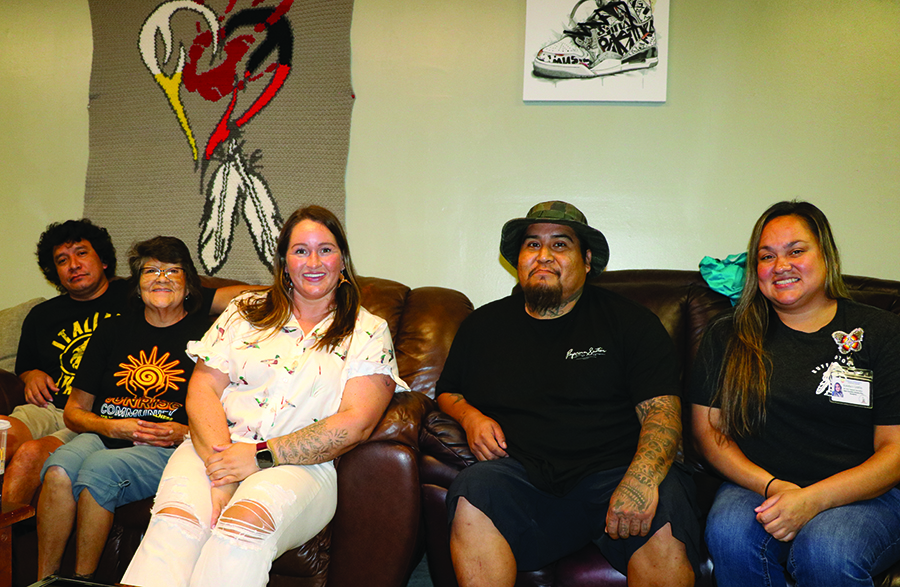
Some of the staff of the Tohi Edasdi Recovery Community Center in Cherokee, N.C. are shown on the morning of Thursday, Aug. 13 including, left to right, Fidel Raya, Siquo Danvhna re-entry peer; Ronda Bradley, Tohi Edasdi peer; Samantha Bradley, Western Regional director; Tristen “Trik” Long, Tohi Edasdi peer; and Kandace Griffin, Siquo Dnvhna re-entry peer. (SCOTT MCKIE B.P./One Feather photos)
By SCOTT MCKIE B.P.
One Feather Asst. Editor
CHEROKEE, N.C. – Just over a year ago, the Tohi Edasdi Recovery Community Center opened in Wayohi (Wolftown) and has hit the ground running providing services for the recovery community.
Tohi Edasdi (“A place of peace”) is part of the Sunrise Community for Recovery and Wellness program which describes itself as “a nonprofit staffed entirely by Certified Peer Support Specialists who draw on their own lived experience of recovery from mental health and/or substance use challenges to support others”.
In addition to Tohi Edasdi, the Siquo Danvhna (“They are Living Again”) re-entry program is housed at the Center. For the past two years, the programs have been funded through the Eastern Band of Cherokee Indians (EBCI) with Opioid Settlement Funds. The program has a partnership with the Cherokee Indian Hospital Authority called the Wellness Connection.
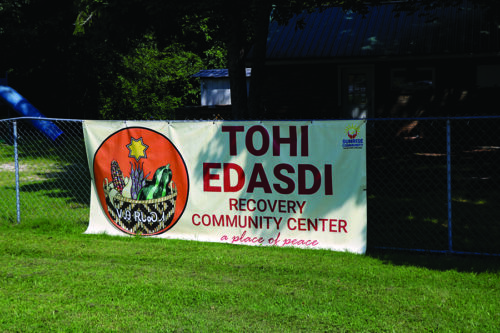
The Tohi Edasdi Recovery Community Center in Cherokee, N.C., shown in this photo taken on the morning of Thursday, Aug. 13, has been serving the community for over a year.
Tohi Esdadi staff includes: Samantha Bradley, Western Regional director; Harold “Bumper” Smith, Western Regional supervisor; Marissa Bradley, Western Regional administrative assistant; Dino Griffin, Wellness Connection peer; Tristen “Trik” Long, Tohi Edasdi peer; Ronda Bradley, Tohi Edasdi peer; Kandace Griffin, Siquo Danvhna re-entry peer; and Fidel Raya, Siquo Danvhna re-entry peer.
“I feel that this is the community’s place of welcome,” said Samantha Bradley who related the program has served over 1,000 people in its first year. “That’s the first and foremost. It belongs to the community. We’re just here as peers to facilitate the space. We’re all certified peer supports, so all of us are in recovery from substances and/or mental health.”
She added, “When people come in with a need, our goal is to help fill the gaps.
I think there’s a misconception that we don’t have houseless people on the Boundary, when we do. They will come here. Whenever the sun rises, they walk down from Blue Wing. This is where they’re at until 4…I think this space has been able to help, in the daytime, have somewhere for them to safely come.”
Some of the services offered at the Tohi Edasdi Recovery Community Center include: clothing, shoes, Narcan, laundry, gatherings, food, hygiene products, tents, transportation, and a safe place to be during the day.
Samantha Bradley spoke of the program’s successes. “We have full-circle moments. Kandace (Griffin) was a participant of ours when we first started our re-entry program. Marissa (Bradley) was her peer support. We worked with her. She went off and got her treatment and came back. And, now is working with us doing that same position that we were helping her with. So, she’s doing re-entry. To me, that’s a super success because we want to build a peer support workforce.”
Griffin commented, “Right now, it’s been four or five months now since starting into this role and having at least eight people wanting to go to treatment from jail. Even if they go to a 30-day program and come out and go to the women’s home, or Oxford House in Asheville, or something, but they’re staying connected. They’re calling even after we helped them. I think that’s really cool because Marissa did that for me. So, being able to do it and being able to give back to the community and help somebody else is a big, important thing.”
Long said he is happy with how the program has been doing its first year. “It’s been building and building, coming together. We’re starting to get a lot of community involvement, people wanting to help how they can.
We offer all the recovery stuff. Then, I try my best to bring a lot of culture and tradition into the gatherings. I’m not an expert on it, but I know a good bit. I kind of grew up around it so I try to bring as much knowledge of that and tie culture in with recovery – try to be very interactive with it, get people thinking.”
He added, “It feels really good to have people come in here and say, ‘man, I love coming here because I’ve never felt judged, I’ve never felt looked-down-upon’. It is a really peaceful place here. I think another one, too, is celebrating the little wins. We’ve got a lot of people that come through here that come in excited to tell us, ‘I passed my next GED test’ or ‘I got my license’.”
Samantha Bradley said, “My dream is continuing to do these programs, but, also, there’s a lot of opportunity…we’ve been talking about a grant where we can partner a mentor, an artist, with someone who’s trying to get into recovery, or is in recovery, but really wants that connection with some type of art. For me, my culture was not a part of my growing up so reconnecting changed everything for me.”
She noted they’re looking at diverse funding streams going forward to create more programming. “I foresee that it’s just going to continue to grow. We serve everyone. Everyone is welcome here.”
Ronda Bradley said they’ve already begun art projects aimed at aiding the recovery process. “We do beading. We do different art things. We’ve done heddle stitch. We’ve done daisy chains. Trick has done pottery paddles with us.”
Raya summed up the feelings felt by the staff during the first year. “I love my job. It’s rewarding whenever they call us and say, ‘Yo, I got the job’ or put you down as a reference, or anything like that…hearing their personal goals being achieved and reached. It’s very rewarding to see our community start to thrive again.”
The Center is open Monday through Friday from 9 a.m. to 4 p.m. For more information, call (828) 506-8505.