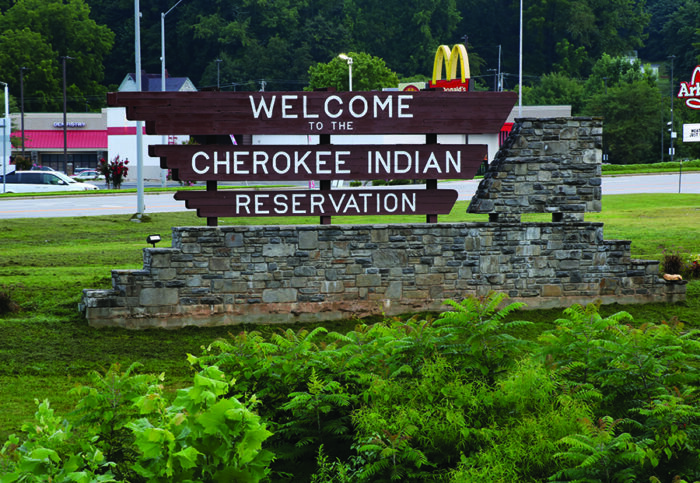
This sign welcomes visitors to the Qualla Boundary entering the tribal lands of the Eastern Band of Cherokee Indians from U.S. 441. (SCOTT MCKIE B.P./One Feather photos)
By SCOTT MCKIE B.P.
One Feather Asst. Editor
CHEROKEE, N.C. – The signs welcoming people to the lands of the Eastern Band of Cherokee Indians will be getting a facelift soon.
Dinilawigi passed Res. No. 274, submitted by Ugvwiyuhi (Principal Chief) Michell Hicks, during its regular session on Thursday, Aug. 6. The legislation authorizes Ugvwiyuhi Hicks to “designate the appropriate tribal departments, including Cultural Resource departments, Cherokee Language programs, Executive Public Relations, Commerce, and other relevant programs to collaborate in the development of signage concepts that are historically accurate, culturally appropriate, visually welcoming, and representative of the Eastern Band of Cherokee Indians for both present and future generations.”
The whereas section of the legislation, which was passed unanimously, outlines the reason for the desired change to the signage. “The Qualla Boundary is the homeland of the Eastern Band of Cherokee Indians, comprised of lands painstakingly reacquired through the determination and sacrifice of Cherokee ancestors and held in trust for the Tribe, representing the perseverance, resilience, and self-determination of the Cherokee people; and the existing gateway signage was designed for another era and no longer fully reflects the history, culture, governmental maturity, Cherokee language, or sovereign status of the Eastern Band of Cherokee Indians.”
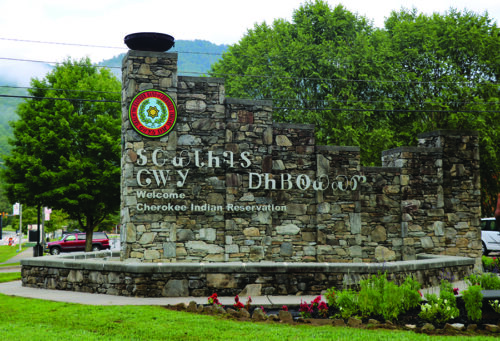
This sign welcomes visitors to the Qualla Boundary entering the tribal lands of the Eastern Band of Cherokee Indians from Newfound Gap Road in the Great Smoky Mountains National Park.
It continues, “The signs welcoming residents and visitors onto the Qualla Boundary should accurately represent the Eastern Band of Cherokee Indians as a sovereign tribal nation while honoring the rich history, living culture, and legacy of the Cherokee people.”
During discussion on the legislation on Thursday, Ugvwiyuhi Hicks commented, “I think it is time to really exert sovereignty into the signage. I think it is time to restate who we are.”
Elawodi (Yellowhill) Rep. Shennelle Feather commented, “I love this piece of legislation. I appreciate it so much, and I love that you’re including community input.”
Kolanvyi (Big Cove) Rep. Lavita Hill said, “I love the idea that we are moving away from the term reservation since that is not the history of our land.”
She added that a lot of products use the terms ‘Reservation’, ‘Rez’, and ‘Rezzy’. “We should be mindful of how we use that going forward.”
Tutiyi/Tsalagi Gadugi (Snowbird/Cherokee Co.) Rep. Adam Wachacha said he supports the legislation and made it clear that the Qualla Boundary includes Tutiyi and Tsalagi Gadugi which will be included in this gateway signage project.
Res. No. 274 further states, “The Office of the Principal Chief shall compile and review the community input and naming suggestions previously submitted through the Cherokee One Feather regarding gateway signage and use that feedback in developing proposed signage verbiage. The proposed signage language shall be developed in collaboration with the appropriate tribal programs and present to Tribal Council for review and approval within 90 to 120 days of the adoption of this resolution. Upon completion of the design process and consultation with the appropriate federal and state agencies, the Principal Chief shall present the proposed gateway signage concepts and any necessary agreements to the Tribal Council for review and consideration before implementation.”
Res. No. 274 concludes by stating, “While the purpose of welcoming visitors remains unchanged, the story we tell has grown. As visitors enter the Qualla Boundary, the gateway signs should reflect not only where they are, but who we are, a sovereign Tribal Nation whose homeland, history, culture, language, and future continue to thrive.”