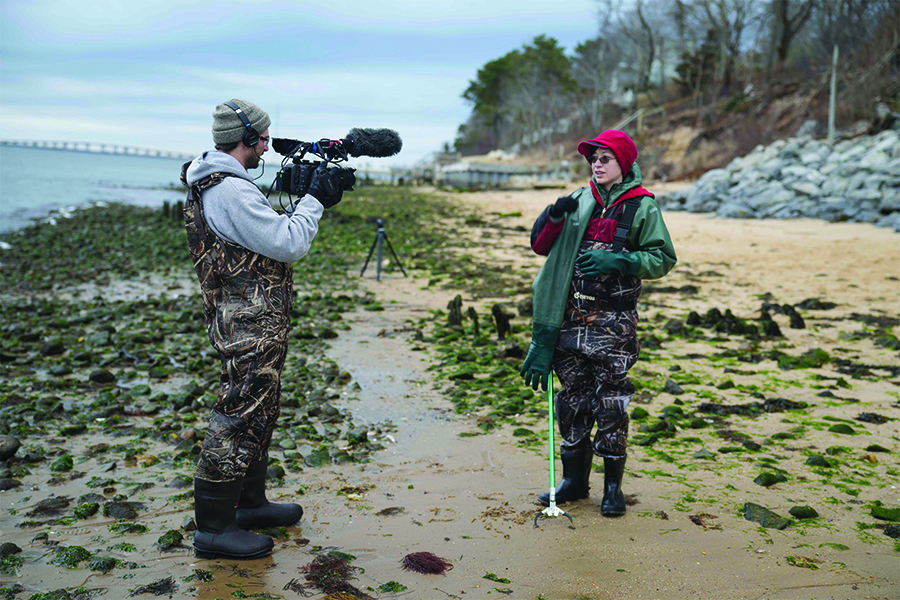
Nathaniel Cummings-Lambert and Waban Tarrant are shown in this production still from “Women of the Stoney Shore”. (Photo contributed)
By ANN TOINEETA
One Feather Intern
“Women of the Stony Shore: Shinnecock Kelp Farmers”, Nathaniel Cummings-Lambert’s new documentary, takes a close look at the traditional Shinnecock practice of kelp farming. The documentary follows a group of six Shinnecock women through a full year of harvesting along Long Island’s Shinnecock Bay in New York. This practice is shown as an exercise of sovereignty and fight against the pollutants that have harmed their waters.
“Women of the Stony Shore” will be screened at The Way We See The World, an event spotlighting Indigenous pop culture organized by the Museum of the Cherokee People. The event will be held on Friday, Aug. 7 in the Council Fire Ballroom at Harrah’s Cherokee Casino Resort from 5 p.m. to 8:30 p.m.
Cummings-Lambert, a member of the Eastern Band of Cherokee Indians, who directed, edited, and produced “Women of the Stony Shore”, created this documentary as a project for his PhD program. Over the span of two semesters, he was able to learn all about the kelp farmers’ mission and their process.
The following is a brief synopsis of the documentary:
“Women of the Stony Shore follows a multigenerational coalition of Shinnecock women who use kelp farming to counter ecological damage to the waters surrounding their traditional homelands. The film documents the full arc of the growing season: seedlings cultivated in aquarium tanks each fall, transferred to anchored ocean lines in December, and harvested the following spring. Throughout the growing season, we meet the six women behind this regenerative aquaculture initiative and learn how their work draws pollutants from the bay’s waters while exercising sovereignty and reclaiming a practice rooted in centuries of Shinnecock seaweed harvesting.”
Cummings-Lambert said, “I really wanted to show the full process of the kelp farming throughout the season. For me, it was also important to sort of be slow and follow the whole growing season from beginning to end to show what is involved with everything.”
What primarily stood out to Cummings-Lambert while making the documentary was the incredible resilience and dedication of the Shinnecock. Even though their operation is small, they are constantly expanding.
“The size of their reservation is really small compared to other communities, but they’re able to do a lot of work with the resources that they have and that’s really inspiring,” he said.
Cummings-Lambert also described the Shinnecock women as very welcoming and is happy that this experience has allowed him to form a relationship with them.
“I was very grateful to be able to work with the Shinnecock Kelp Farmers because I didn’t really know them and they trusted me to make a film as someone outside of their community,” he said. “They’re just really generous with their time.”
Cummings-Lambert hopes that “Women of the Stony Shore” will allow audiences to connect their own experiences with those from other Native communities.
“A lot of the things that the Shinnecock Kelp Farmers were telling me sounded very familiar to the experiences of folks back home in Cherokee,” he said. “I hope that folks will see the broader relationship between what they’re trying to accomplish and things that are happening in other Native American communities as well.”
To learn more about the Shinnecock Kelp Farmers, go to shinnecockkelpfarmers.com. Reserve your free tickets for The Way We See The World via the event’s Eventbrite page.