
By SCOTT MCKIE B.P.
One Feather Asst. Editor
MURPHY, N.C. – The Town of Murphy approved a resolution on Monday, July 6, 2026 to transfer the Fort Butler Park and Historical Site, aka Fort Butler Memorial Park, to the Eastern Band of Cherokee Indians (EBCI). This will occur at no cost to the EBCI.
EBCI Ugvwiyuhi (Principal Chief) Michell Hicks said in a statement, “I want to thank the Murphy Town Council, Mayor Tim Radford, and especially Tia Lambert for their advocacy and commitment in supporting the return of Fort Butler Park and the surrounding historic site to the Eastern Band of Cherokee Indians. There have been many conversations with the Executive Office to help make this possible, and I am very thankful.
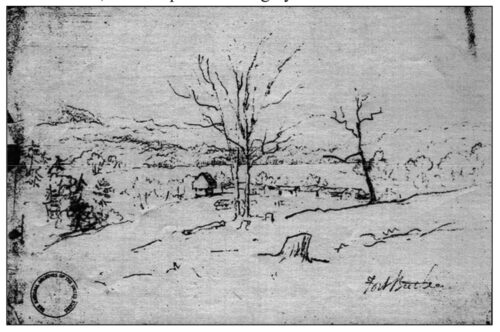
Sketch of Fort Butler, December 1837 (U.S. Army public domain image)
Fort Butler served as the military headquarters for the Cherokee Removal in 1838. It was here that Cherokee families were detained before being forced from their ancestral homelands on the Trial of Tears. The opportunity to return places like Fort Butler to Cherokee stewardship is an important part of preserving our history and strengthening our sovereignty. It allows us to ensure that this story is told truthfully, that those who suffered here are honored, and that future generations understand both the hardships our people faced and the resilience that continues to define the Cherokee people today.”
Ugvwiyuhi Hicks added, “Preserving Fort Butler in a way that honors its history and helps future generations better understand its significance remains an important priority. An official acceptance event will be planned soon, with the community playing a central role in this historic occasion.”
Murphy Mayor Tim Radford said in a statement, “This is an important step for our community. Fort Butler is tied to a painful chapter in Cherokee history. While the park is located in Murphy, I believe the Eastern Band of Cherokee Indians should have the opportunity to care for this site and share its history in their own voice.
The more I thought and prayed about it, the more it made sense. This is not Murphy stepping away from its history. It is about recognizing that history honestly, showing respect, and placing stewardship of this important place with the people most directly connected to its story.”
According to the resolution, the land was conveyed to the Town of Murphy from the Tarheel Investment Company, Inc. on Sept. 1, 1925.
Originally named Camp Huntington, it was renamed Fort Butler in 1837 after Benjamin Butler, U.S. Attorney General under President Andrew Jackson.
Dr. Brett Riggs, an honorary member of the EBCI, and Dr. Lance Greene wrote a paper entitled “The Cherokee Trail of Tears in North Carolina: An Inventory of Trail Resources in Cherokee, Clay, Graham, Macon, and Swain Counties” which details various sites relating to the Removal.
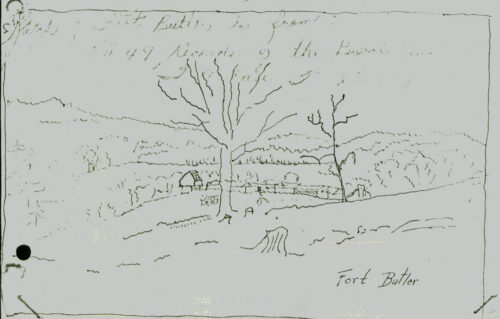
Sketch of Fort Butler, February 1838 (Photo courtesy of Museum of the Cherokee People, 2009.003.0593)
In that paper, they write, “Fort Butler, located in present-day Murphy, North Carolina, was headquarters to the Eastern Division of the Army of the Cherokee Nation during the military removal operations of June and July 1838. The fort, with nearly military encampments, hospital, offices, barracks, and other facilities, was the holding area for Cherokee detainees from North Carolina and a staging ground for the forced marches of Cherokee prisoners to the primary internment camps and emigration depot at Fort Cass (now Charleston, Tenn.). More than 3,000 Cherokee prisoners passed through Fort Butler in the initial stage of the Trail of Tears exodus. As headquarters for the military removal from southwestern North Carolina, and the central location at which North Carolina Cherokees were gathered, Fort Butler is arguably the most historically significant Trail of Tears associated site in North Carolina.”
It adds, “Major Gen. Winfield Scott assumed command of the U.S. Army of the Cherokee Nation at Fort Cass in April 1838, divided the army into three administrative divisions, and designated Fort Butler as headquarters for the Eastern Division…Scott directed Brigadier Gen. Abraham Eustis to take charge of the Eastern Division of the army based at Fort Butler…following the chaotic militia roundup of Georgia Cherokees in late May, Scott suspended further removal operations in North Carolina, Tennessee, and Alabama until June 12, 1838. Because army intelligence considered the North Carolina Cherokees the most likely to resist the military removal, Scott personally came to Fort Butler to observe the resumption of the military operations and to be on hand in case of hostilities. Troops from Fort Butler and its satellite posts deployed into the surrounding Cherokee communities on June 12 and game the military detention of Cherokee citizens without serious incident.”
The paper also states, “The Cherokee prisoners brought into Fort Butler during the first military sweep spent less than a week in camps on the banks of the Hiwassee River before troops moved them to the ‘emigration depot’ at Fort Cass and the Cherokee Agency. The first group of Cherokee prisoners departed Fort Butler on June 18, 1838.”