By SCOTT MCKIE B.P.
One Feather Asst. Editor
Bryce Teesateskie is an up-and-coming documentary filmmaker with a passion for visual storytelling and vision for cultural preservation. A member of the Eastern Band of Cherokee Indians from Tutiyi (Snowbird), he graduated summa cum laude (with a 4.0 GPA), from the Savannah College of Art and Design (SCAD) Atlanta campus in spring 2026.
Growing up, Teesateskie was always a fan of movies and visual storytelling.
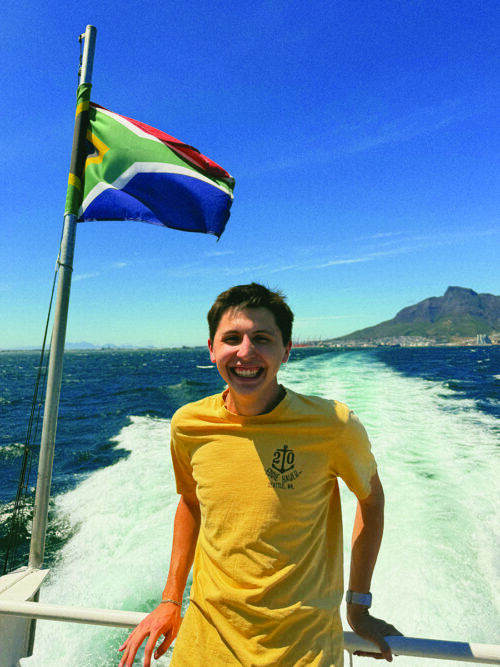
Bryce Teesateskie, a member of the Eastern Band of Cherokee Indians from Tutiyi (Snowbird), is shown in South Africa where he served as director and producer on a documentary entitled “Silence Meets the Shore” about endangered South African penguins. (Photo contributed)
“I just always enjoyed media and pop culture and those things. Then, when I got to the end of high school, thinking about what I want to do with my life and career-wise, my family had gone on a road trip the summer before I graduated high school and I had made these little videos, essentially documenting our road trip. I had never done anything like that before, so after that I realized I enjoy this whole videoing and documenting and capturing these moments in time.”
In December 2025, he was selected to be part of a team of documentarians to go to South Africa. The result of that trip was a documentary he worked on entitled “Silence Meets the Shore” about endangered South African penguins.
“There were 15 of us that went but it got split up into smaller groups and we got to decide what we wanted to focus on. So, me and two of my classmates filmed a documentary short about the endangered South African penguins in Cape Town. That was a really fun project and a really fun experience to get to go and travel. That was the first time I’ve ever been abroad. I’ve traveled a lot in the U.S. but never went overseas like that so that was a really fun thing. That was, apart from my senior thesis, one of the projects that I’m most proud of and that was the most interesting.”
His experience there was a large learning experience that he values greatly.
“I think the biggest difference is the lack of a safety net. With the student work, it’s sort of self-contained. When it’s purely for an assignment in class, then you know that ‘if this goes wrong, if it doesn’t turn out exactly the way I want’, really no harm, no foul. It’s all about just learning. But, when we went to South Africa, we’re using other people’s time and resources and asking a lot more of other people.
Having that pressure to be professional and do it well and that we were putting a lot more time and resources into it. So, we wanted it to be good, not only for our sake but for the people that we were working with – for their sake. We wanted it to be something that they could watch and be proud of.”
Teesateskie was the director and producer on the project, and he was paired with three other students who did sound, photography, and editing.
“When we were coming up with the idea of the penguins, all of us had an interest in something ecological or with the landscape – we knew that we wanted to do something nature-focused. So, when we were looking into some of the most notable, interesting parts of the South African ecosystem, that was when we came across the South African penguins and how they’re endemic to that location. They are really part of not only the culture of the environment – that it’s something that the people there feel connected to because it is so specific to their location – but also how it’s important to the larger ecosystem and the role that those penguins play.”
He said the ecological diversity was similar to his home in the mountains.

Teesatskie is shown in the One Feather office recently. (SCOTT MCKIE B.P./One Feather photo)
“It was similar in the way that the people we spoke to had this same sort of connection to the land as we do here and the feeling of not only needing to protect it, but sort of living in harmony with it and having a respect for the land. How the plants and the animals and the landscape are an important part of the culture of the people, similar to how we are here.
For the locals there, there is that respect and care for the natural world that I would say is similar to what we have here. But, then the biggest difference, of course, is what the natural world looks like. We have the elk here and the deer and the birds, and we have our mountain range. But, over there, rather than elk, it’s penguins and it’s monkeys.”
To graduate from SCAD, Teesateskie had to complete what is called a capstone project which takes an entire academic year. He completed a documentary on B.J. Welch and his work with river cane in a Cherokee arts class at Robbinsville High School in Graham County, N.C.
That project spurred an interest.
“After doing that project, I got a lot more interested in Cherokee arts and it made me see the need for documenting and preserving these crafts in video and photo, sort of similar to the language and how it’s rapidly dying out and how the Tribe’s making efforts to combat that. Similarly, I can see how the crafts are slowly fading away. We’re teaching them to the youth and doing these things, but in a lot of ways when our elders pass away, they’re going to take a lot of knowledge with them. Even though we’re teaching the next generation a lot of this stuff, there’s still a level of expertise and skill that our elders have that you can learn from someone that learned from them, but it’s still not as impactful as learning from some of them just because of the wealth of knowledge that they have. So, I had seen the need for this and the benefit that it can have.”
Teesateskie’s long-term goals will center around this work.
“Now, post-grad, what I’m wanting to do more with my time is devote the next couple of projects that I work on to document and preserve some of these crafts in our community. That way, five, ten, fifteen years from now, even after some of our elders have passed away, people can still go back and watch a video of one of our craftsmen and women making a basket or beadwork – be able to watch and see specifically how they did it with their hands, what specifically they did, and what materials they used…that way we’ll have these things documented and we’ll have this history preserved and we’ll be able to preserve and protect it.”
He added, “People in the surrounding region and across the nation sometimes forget that Natives even exist or they forget that these communities exist and that these people are still here. I think the biggest way to use our voice as a people in the modern age is through video and through media. I really do think that is the strongest way to represent ourselves and to make our voices heard.”
Teesateskie’s documentary, “Silence Meets the Shore”, is doing a festival run soon and won’t be available for public viewing until afterwards. Once it is available for public viewing, the One Feather will share that information.