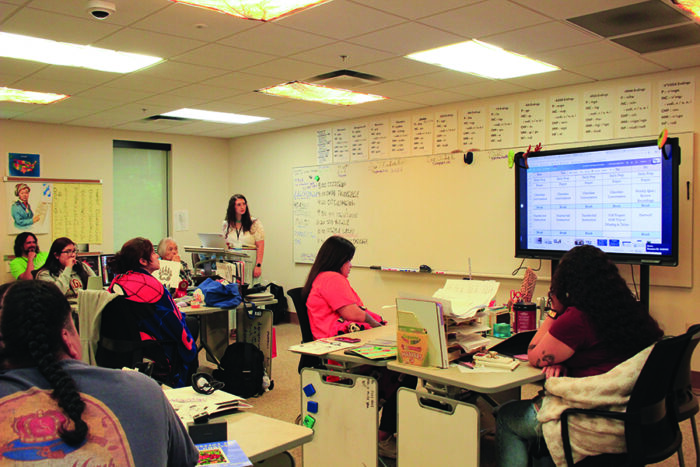
Scarlett “Gigage” Guy, adult language educator for CLMAP, speaks during a breakout session on Wednesday, June 24 as part of a workshop to develop a three-year curriculum for adult Cherokee language learners. (ANN TOINEETA/One Feather photos)
By ANN TOINEETA
One Feather Intern
CHEROKEE, N.C. – Members of the Kituwah Preservation & Education Program (KPEP) and the Cherokee Language Masters Apprentice Program (CLMAP) – both programs of the Eastern Band of Cherokee Indians (EBCI), along with visitors from the Cherokee Nation and Akwesasne Mohawk tribes, and others gathered at New Kituwah Academy on June 24-25 for a workshop to develop a three-year curriculum for adult Cherokee language learners.
The first day of the workshop offered the group of visitors, which included members of Cherokee Nation’s CLMAP and the Mohawk Kanienʼkéha and Ionkwahronkha’onhátie’ adult language programs, the opportunity to observe the current curriculum CLMAP is teaching their students. The program is currently two years long, and each cohort has the same teacher for both years.
Taylor “Taluts” Wilnoty, curriculum instruction coordinator for CLMAP and KPEP, said that this workshop is just the beginning of a much bigger discussion for their curriculum.
“Our goal at the end of this workshop is to gather as much feedback and recommendations from all our stakeholders and then compile it into a cohesive, three-year curriculum for adult language learners,” she said.
The workshop started with introductions from the visitors and a short overview by Renissa McLaughlin, EBCI director of youth and adult education.
“We have a wide variety of people in this room and I think that we’re going to have a really good conversation,” McLaughlin said. “One of the core values I just wanted to bring out…is group harmony, and I hope that today as we move through our conversations with each other, that we’re going to move through this day in harmony.”
Wilnoty then explained more about the goals of CLMAP and the workshop.
“Together, we are working to build a curriculum that honors our language, reflects our culture, and supports learners as they grow in proficiency, confidence, and connection,” she said. “We want strong curriculum recommendations, language development framework, proficiency assessment considerations, and resources and teacher support needs.”
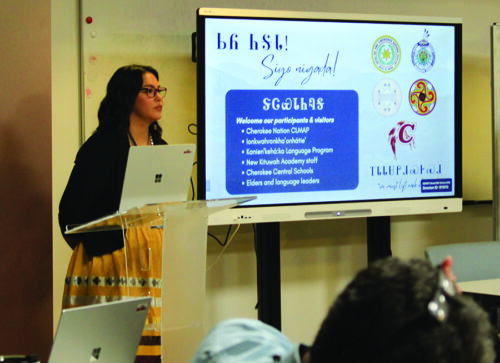
Taylor “Taluts” Wilnoty, curriculum instruction coordinator for CLMAP and KPEP, speaks during the first day of the curriculum development workshop.
Aaliyah Swimmer and Scarlett “Gigage” Guy, adult language educators for CLMAP, shared their current curriculum and teaching strategies.
Swimmer, who is teaching the first year of her cohort, explained that the first-year curriculum builds a foundation for the language with vocabulary categories like clothing and body parts. Guy, who is teaching the second year of her cohort, said the second year focuses more on working in depth with first language speakers. Both years also integrate their student’s language learning with the community through cultural field trips.
Guy then spoke on how she hopes this workshop and further developing the CLMAP curriculum will help students reach higher levels of proficiency when the first language speakers are no longer here to help them.
“I know for a fact that the things I’m doing right now, I absolutely could not do without the first language speakers,” she said. “It concerns me that if we don’t have something that can get students to the level they’re at with speakers, then what will we do when they’re not here with us? That’s something I would greatly appreciate advice about- going to prepare for that.”
The workshop then moved onto classroom observations. In the first-year classroom, Swimmer had her class play a game where two students compete to choose the right Cherokee word first. In the second-year classroom, Guy explained how the Dadiwonisi Picture Set Assessments are conducted. Students have to answer various questions from first language speakers about situations in a particular picture in Cherokee. Additionally, Guy discussed how the second-year curriculum is currently less structured than the first.
“It’s not that we don’t have resources or the help, it’s more about gathering it all and getting it aligned, and getting it edited, and getting it prepared, and being able to follow up on it,” she said.
After the classroom observations, Francis Hartwell, a New Kituwah Academy curriculum developer, explained more about the picture assessments and how they’re recorded. Following this, the visitors were provided with the chance to give feedback and ask questions about what they observed.
Wilnoty said the breakout sessions later in the day focused on “building a cohesive three-year curriculum where language, culture, assessment, and learning experiences are intentionally built from Year 1 through Year 3.”
“Participants also emphasized more authentic language use, integrating culture throughout instruction, and clear milestones for learner growth,” she said.
A major takeaway from the breakout sessions was that their goal is to produce “lifelong Cherokee language advocates,” not just fluent speakers.
“No matter what path graduates choose, we hope they continue carrying the language forward,” Wilnoty said. “Keeping our Cherokee language alive is our shared purpose, and we don’t necessarily need to place labels on fluency.”