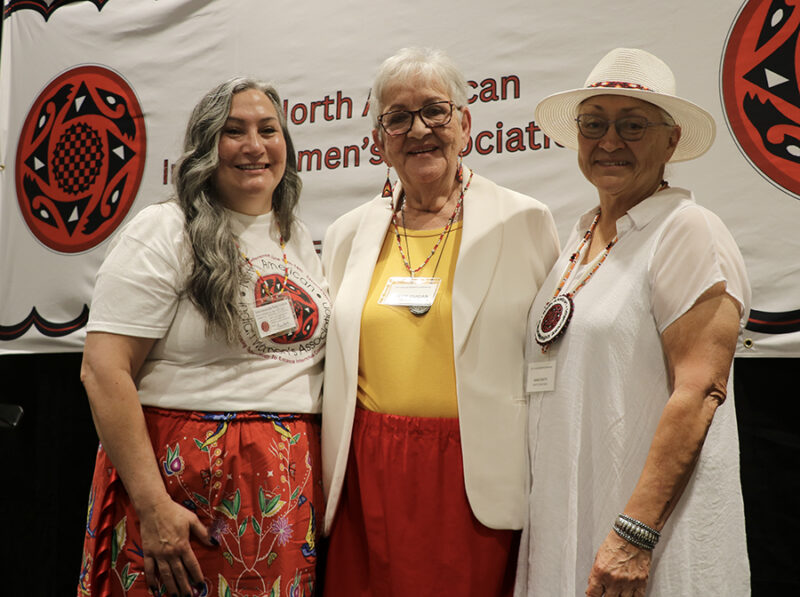
The National NAIWA (North American Indian Women’s Association) Conference, hosted by the Eastern Band of Cherokee Indians (EBCI), opened at Harrah’s Cherokee Casino Resort in Cherokee, N.C. on the morning of Monday, June 8. Former EBCI Ugvwiyuhi (Principal Chief) Dr. Joyce Dugan, center, gave the keynote address to open the Conference. She is shown with Eileen Briggs (Cheyenne River Sioux), left, NAIWA national vice president; and Diane Booth (Cheyenne River Sioux), national president. (SCOTT MCKIE B.P./One Feather photos)
By SCOTT MCKIE B.P.
One Feather Asst. Editor
CHEROKEE, N.C. – Women from around Indian Country gathered at the recent 54th Annual NAIWA (North American Indian Women’s Association) Conference to share ideas and culture. The Eastern Band of Cherokee Indians (EBCI) hosted the event at Harrah’s Cherokee Casino Resort in Cherokee, N.C. from June 8-10. The theme of the conference was “Unified Minds Bring Harmony: Betterment of Home, Family Life, and Community”.
At the beginning of the session on June 8, participants recited the NAIWA Preamble which outlines the goal of the organization. “We, North American Indian Women, with quiet dignity and pride, inherent with our racial heritage, unite with determination to promote through unity of purpose the general well-being of Indian people.”
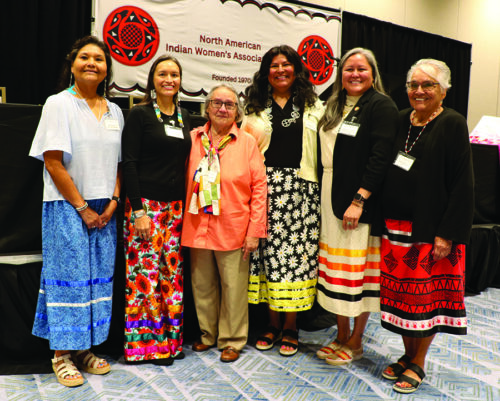
A panel entitled “The Role of Women as Government Leaders” was held at the National NAIWA (North American Indian Women’s Association) Conference, hosted by the Eastern Band of Cherokee Indians (EBCI), at Harrah’s Cherokee Casino Resort in Cherokee, N.C. on the morning of Tuesday, June 9. The panel included Kolanvyi (Big Cove) Rep. Venita Wolfe, left; Aniwodihi (Painttown) Rep. Shannon Swimmer, second from left; Kolanvyi Rep. Lavita Hill, third from right; and Elawodi (Yellowhill) Rep. Shennelle Feather, second from right. They are shown with EBCI Beloved Woman Carmaleta Monteith, third from left; and Lucille Wolfe, NAIWA Cherokee Chapter president, right.
Diane Booth, a member of the Cheyenne River Sioux Tribe who serves as NAIWA national president, told the group at the start of the Conference on June 8, “As we gather on this beautiful morning for the 54th session of the North American Indian Women’s Association here in the homelands of the great Cherokee Nation, we come together in sisterhood to listen, learn, and be inspired by our distinguished speakers. We also gather to share our thoughts, experiences, and wisdom with one another, strengthening the bonds that unite us as Native women across our nations and communities.”
Driver Blythe, an EBCI tribal member who serves as the EBCI public policy analyst, was in attendance on June 8 representing the Office of Ugvwiyuhi (Principal Chief) Michell Hicks. “I was raised by a strong mom and by strong women in my family. And, even though I deserved a switching every now and then, I knew they were leading me in the right path.”
Blythe added, “It is important to remember that through a matriarchal society, historically, and a matriarchal society that we should be, that women lead and that the NAIWA, North American Indian Women, are not just leading, they’re teaching.”
The keynote address for the conference was given on the morning of June 8 by former EBCI Ugvwiyuhi Dr. Joyce Dugan. “I think our generation has been taken care of by strong women…those mothers and grandmothers were strong women, and I hope all of us inherit those qualities.
I believe that the women are the backbone of our tribe. The children are the heart…it’s women that hold the home together. We have learned to multi-task. We cook, we clean, we iron, we wash, we work in the garden – on and on…yet, while doing all this, women have been able to work on projects to better the community, just like you do.”
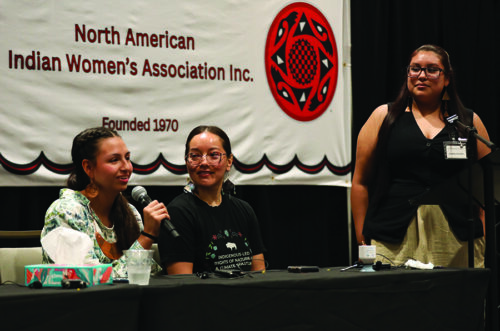
Jasmine Smith, seated left, speaks during a panel discussion entitled “The Journey to Rights of Nature for our Waterways” at the NAIWA National Conference held at Harrah’s Cherokee Casino Resort in Cherokee, N.C. on the morning of Tuesday, June 9. Smith, a member of the Eastern Band of Cherokee Indians (EBCI) and co-founder and chairperson of the NAIWA Daughters, was joined on the panel by Isabella Zizi (Three Affiliated Tribes, Northern Cheyenne, Muskogee Cree), seated right, Movement Rights Indigenous community organizer. The panel was moderated by Kyndra Postoak, standing, an EBCI tribal member and NAIWA Daughters member.
She said women are needed in leadership roles. “I was the first woman to be elected to the office of the Principal Chief. I say it’s time for women to step up. With all that tribes are facing, internally and externally, we need leaders who can multitask and I know women can do that.”
Two panel discussions were held on June 9 including:
- “The Role of Women as Government Leaders” – The panel included: Kolanvyi (Big Cove) Rep. Venita Wolfe, Aniwodihi (Painttown) Rep. Shannon Swimmer, Kolanvyi Rep. Lavita Hill, and Elawodi (Yellowhill) Rep. Shennelle Feather. It was moderated by Angelina Jumper, an EBCI tribal member who serves as the Junaluska Museum cultural resources supervisor. View this panel in its entirety here.
- “The Journey to Rights of Nature for our Waterways” – Jasmine Smith, an EBCI tribal member and co-founder and chairperson of NAIWA Daughters, was joined by Isabella Zizi (Three Affiliated Tribes, Northern Cheynne, Muskogee Creek), who is the Indigenous community organizer with Movement Rights. This panel was moderated by Kyndra Postoak, an EBCI tribal member and NAIWA Daughters member. View this panel in its entirety here.
One question asked in the first panel was, “What does it mean to be a leader in a naturally matrilineal society?”
Rep. Feather responded, “Understanding what the roles of clan women, clan mothers, are and what you’re supposed to do in a matrilineal society had made a big impact on my identity…all of those things have really helped me to navigate how I lead in a traditional way – thinking in a mindset that’s decolonized. It’s hard because we’re in a colonial system. This government, this way, and how we are organized is not traditionally who we are and how we operated.
I carry all those women, all my ancestral women who have passed on, and all their knowledge that’s embedded in my mitochondrial DNA that runs my whole body – all my cells…I think about that often and call on that and ask for that guidance.”
Rep. Hill said, “Women should be at the table because women raise their families. Women look after one another. Women care just as much about your children as we do our own. So, women should be here and they had been here for centuries.
We are so looking forward to when our entire government is female. That’s the goal…let’s start preparing our next leaders right now in order to carry on our matrilineal society. It’s beautiful. It’s the best thing that could happen to this community and I think that we’re ready for it.”
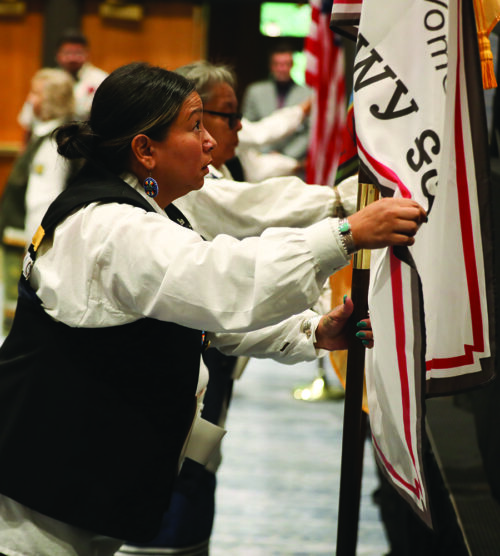
Chavella Esquivel McCoy, a member of the Eastern Band of Cherokee Indians and a U.S. Navy veteran, posts the NAIWA flag during the opening ceremonies of the conference on June 8.
Another question asked what life experiences best prepared the women for their current leadership role.
Rep. Swimmer stated, “The life experience that best prepared me for this role would be motherhood. It’s a role that a lot of times you have to make decisions that aren’t very popular. You have to sometimes take that criticism and just keep moving and keep doing what’s right. That’s one of the things that I think is very important in a role like this where you’re making decisions that aren’t always going to be the most popular, but that would benefit the most people – always doing what’s right. Teaching my kids that and then having them still looking to me for that makes it easier to make those hard decisions in this role.”
It means everything to me to be a leader in a matrilineal society and to be a leader for our tribe.”
Rep. Wolfe commented, “Being raised by a strong mother and strong grandmothers and strong women in my family has really helped me in this role because it’s not easy to be in a position where you have to decide on things that don’t benefit you personally or your community but benefit everybody. Having strong role models, the women that were around me, the way I was raised has helped me be strong in myself.
It’s amazing to be a woman in this position at this time, primarily because this past Council was all men…so, having all four new women come up and having two new women change over seats in our community – because Lavita and I are both from the same community – that was amazing to me. To see that the strength of a woman was needed. The strength that we bring, the ideas that we bring, the differences in our backgrounds that we bring, was much-needed for this Council, for this time.”
At the end of the panel, Jumper said, “Seeing Cherokee women serve in these roles gives me hope and reminds me of the possibilities that we have for future generations. Their service is a powerful example of leadership, dedication, and commitment to our people. Their service reflects not only a significant milestone in contemporary tribal leadership, but also enduring strength, resilience, and contributions of Cherokee women who have long played vital roles in guiding and sustaining our people.”
In the second panel, Smith spoke of the importance of water within tribal societies and life. “We all understand as Indigenous people that water is life. We are centered around that being.”
She added, “Understanding that this work is not for us, it is to honor those who have come before us for us to be able to stand here today and advocate. But, also doing it for the future generations. It is for that great-great-grandchild that I will never get to meet but knowing that I did everything in my power to make it a better world for them.”
Zizi commented, “I feel like the future of Rights of Nature is already here. For instance, me sitting next to Jasmine and Kyndra moderating…thinking about all of the younger people that are really engaged in this movement.”
Postoak spoke of the advocacy work being done by the NAIWA Daughters group. “It very much is for the future of our people. Our work, the work that you, even, are putting in today is for the future generations to come.”
In addition to the panel discussions, there were several other presentations during the conference including:
- “Rooted in Sovereignty, Building the Future: EBCI Food Sovereignty in Action”, presented by Desirae Abella, EBCI environmental and natural resources area specialist agent
- “Qualla Boundary MMIW: Turning Advocacy into Action”, presented by Maggie Jackson and Loretta Bolden
- “The Evolution of Federal Tribal Recognition and its Impact on NAIWA”, presented by Sarah Sneed
The conference also included tours of the Qualla Boundary including viewing a performance of “Unto These Hills” outdoor drama.