By SCOTT MCKIE B.P.
One Feather Asst. Editor
CHEROKEE, N.C. – Beauty and incredible artistry were on display as this year’s Didanisisgi Gadagwatli (Mud Daubers) Pottery Exhibit opened at the Museum of the Cherokee People in Cherokee, N.C. on the evening of Friday, June 5. 19 pottery students – mostly members of the Eastern Band of Cherokee Indians (EBCI) – showcased their work they produced during a multi-months class taught by Tara McCoy, an EBCI master potter.
This is the fifth year of the program.
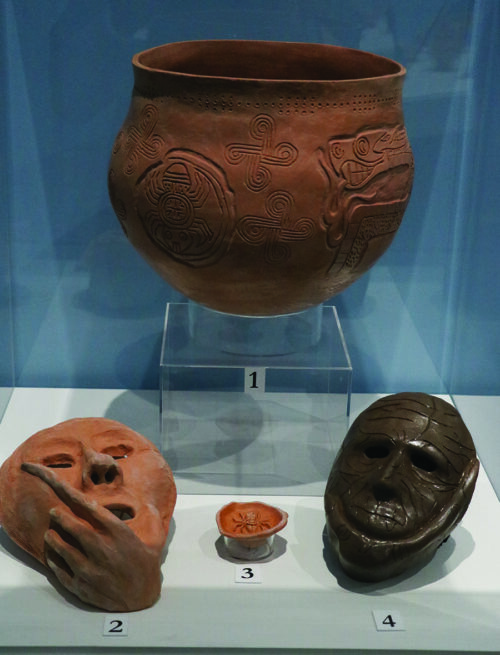
This year’s Didanisisgi Gadagwatli (Mud Daubers) Pottery Exhibit opened at the Museum of the Cherokee People in Cherokee, N.C. on the evening of Friday, June 5. 19 pottery students – mostly members of the Eastern Band of Cherokee Indians (EBCI) – showcased their work they produced during a multi-months class taught by Tara McCoy, an EBCI master potter. (SCOTT MCKIE B.P./One Feather photo)
The pieces shown in the photo are: (1) “The Unbroken Way” by Kevin Jackson (EBCI), (2) “Caress of Utlvta” by Kimberly Reed (EBCI), (3) “Water Spider Effigy Dish” by Isabella Myers-Tasevoli (Cherokee Nation), and (4) “The Wicked Hairstylist” by Trista Welch (EBCI).
Shana Bushyhead-Condill, Museum of the Cherokee People executive director, commented, “Tara recognized that there was a decline in pottery making in our community and she took it upon herself to solve that problem. She is a master ceramicist herself, so she took the time to make an actual class that teaches how to make pottery from start to finish. So, processing clay, being inspired by the collections that we’re honored to hold at the Museum of the Cherokee People, learning different methodologies that we would have used as Cherokee people, all the way to the firing process.”
She added, “The other thing I love is that there are no rules. One of the questions that we get from visitors all the time is, ‘why is this replica pottery on display?’” And, we always say, ‘it’s not replica pottery. This is Cherokee pottery. It may not look like what you expect to see, but anything that a Cherokee artist makes is Cherokee’.”
Bushyhead-Condill praised McCoy and all of the students for the work noting, “A lot of times these artists have never touched clay before. This is just something that they are picking up for the very first time. When you look at the exhibition, you’ll be amazed along with me. It’s just incredibly powerful to see the blood memory that lies within us as Eastern Band Cherokee people.”
McCoy recognized each student with a certificate. She told the crowd gathered, “I’m glad that we’re all here today to support artists and to uplift not only art but pottery in general.
I’m excited every year before every class. I’m excited for what the students make. It’s all the students. I just give them some techniques and some tools and they just run with it. A lot of times they come up to me and say, ‘I haven’t ever done pottery. I have never taken a class’ so I always just like talking to people about blood memory – memories of our ancestors coming through our DNA. I think our people are so creative. You don’t have to give them much instruction, you just give them a pencil, a paintbrush, or some clay and they just take off with it.”
At the exhibit, each student provided a statement regarding the class.
Samantha Bradley (EBCI)
“Getting to learn from Tara and all the other mentors, I just absorbed it all. To me, it’s listening to our elders, in that moment listening to people who know more about our culture than me and just taking it all in.”
Karla “Phyll” Reed (EBCI)
“It was fun. We would gather – and work on our pots and just enjoy being with each other, and helping each other, and giving each other encouragement and ideas.”
John Dugan (EBCI)
“She brought us down into the mud hole and we dug the clay out, then we brought it back and we processed it. That was one thing I was missing.”
Kimberly Reed (EBCI)
“Sometimes the clay has a mind of its own and you have to be willing for that clay to go different directions than your original plan – and then I have had a few pieces that broke – and then you realize that there are things that are in your control and things that are not and I think the whole process of pottery it just reminds me of all the different stages of life.”
Selena Herrera (EBCI)
“At one point it got emotional. Just taking a pause at the table in the art room, seeing everybody in the room – we are descendants – touching base with what our ancestors have always done.”
Danica Hill (EBCI)
“Just hearing compliments from people who do good work like that just makes you feel so much better. So, that was really nice working with the older generations of people who do pottery.”
Freida Saylor (EBCI)
“What I know about myself is that I like to take something that is really non-existent or rough and make something beautiful and to me I feel like pottery – you know I need a lot of grace – and it gives me that and it also allows me to create something beautiful and not have any preconceived notions about what I need it to be – and if I mess up, it forgives me and just lets me go in another direction.”
Laura Smith (EBCI)
“Pottery is not for the weak because it’s process, after process, after process, and you’ll get into the third one and it may just crack and be nothing after hours, and hours, and hours or work but then Tara would say, ‘but you learn from that’.”
Jenean Hornbuckle (EBCI)
“That feeling of belonging – human instinct is to want to belong – and because we are a tribe, and because you belong to a tribe, you kind of understand thinking for more than just me. I’m thinking more collectively – and I don’t think it should just be tribal, I think it should be all of humanity.”
Kevin Jackson (EBCI)
“I believe that even though your family may not be potters, it is in all of us. Because we are Kituwah.”
Kevin Tafoya (EBCI, Santa Clara Pueblo)
“I try to draw attention to stories or histories that we have. I want somebody else to take mine and make it better. Showcase our culture, make it all inspiring, and show something that grabs everyone’s interest.”
Akeisha Littlejohn (EBCI)
“The clay processing part was fun. I liked getting out there in the mud – clay – and bringing that out.”
Trista Welch (EBCI)
“I think just from the very first class till now, I’ve noticed my growth. And I feel like if I keep practicing it, I’ll get better and better.”
Jacob Long (EBCI)
“How long have we as a people been sitting around visiting – listening to our elders – teaching us – making pottery. That thought of deep time and connection, it gets to me if I think about it too much.”
Ryleigh Long (EBCI)
“That’s one of the things that’s so powerful about being a Cherokee person – having family in a place for thousands of years – where you know this is where your family comes from. It’s such a powerful thing. I think that’s one of the things that especially motivates you as a person and crafter.”
Isabella Myers-Tasevoli (Cherokee Nation)
“For me to have my original pottery experiences, that I was like I can’t do this, this is so disconnected – I can’t do this at home – I can’t replicate this without this institution. For Tara to go out and be like, ‘alright, there’s the clay, dig it up’ – this is something I can connect to – this is something I can build.”
Davy Arch (EBCI)
“We really need to focus on getting the information out to everyone that will listen – I think that the more people that do that, the more chance we’ll have of the young people picking up bits and pieces that they can turn into the knowledge that will eventually turn into the tribal wisdom that makes us Cherokee.”
Katrina Neff (EBCI)
“It helps me build mindfulness through my craft – I need to remember that I myself am pliable and forgiving like clay.”
Marcus Bradley (EBCI)
“Seeing what could be done with pottery kind of opens your eyes to different ways to do things. So, I thought that was really cool to see so many people’s ways of making pottery.”