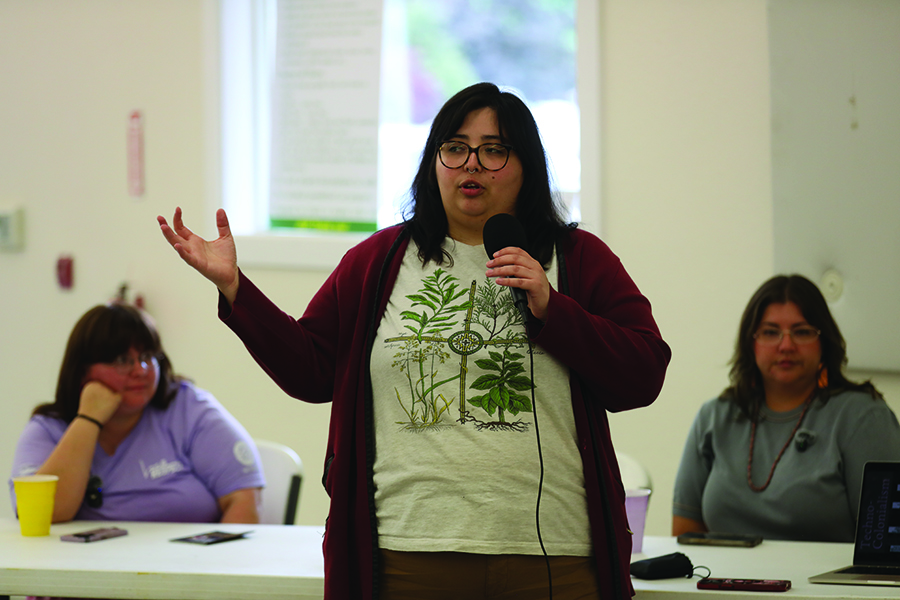
Cheyenne “Chey” Morgan (United Keetoowah Band of Cherokee Indians/Oglala Lakota), Stop Data Colonialism coalition coordinator, speaks at a Data Center Town Hall meeting at the Yellowhill Activity Center in Cherokee, N.C. on the afternoon of Saturday, April 25. (SCOTT MCKIE B.P./One Feather photo)
By SCOTT MCKIE B.P.
One Feather Asst. Editor
CHEROKEE, N.C. – The Eastern Cherokee Organization, a grassroots organization comprised of members of the Eastern Band of Cherokee Indians (EBCI), hosted a Data Center Town Hall to bring awareness of the impacts that the centers can have on a community. The event was held in collaboration with the Indigenous Environmental Network and the Bigwitch Indian Wisdom Initiative on Saturday, April 25 at the Yellowhill Activity Center in Cherokee, N.C.
You can view this meeting in its entirety at the Cherokee One Feather YouTube Channel here.
This meeting was organized to inform the public about data centers. Currently, there is pending legislation in the EBCI Dinilawigi (Tribal Council) concerning data centers.
Ord. No. 158 (2026) seeks to amend Cherokee Code Chapter 47E to place a ban on data centers establishing a Data Center Development Moratorium within the lands of the Eastern Band of Cherokee Indians.
The whereas section of this legislation states in part, “High impact digital infrastructure facilities (herein referred to as data centers), present a clear and present danger to the lands and people of the Eastern Band of Cherokee Indians; and these facilities have often been forced on rural areas in western North Carolina and have made the quality of life considerably worse for those who live nearby them.”
It continues, “These facilities require an enormous amount of water to operate, and we recognized that our water is sacred and should not be used for this purpose; and it is well documented that these facilities create a humming sound which causes nearby residents to develop health problems of both a physical and mental variety.”
The ordinance calls for the moratorium to “remain in effect indefinitely”.
Ord. No. 158 was submitted by Kolanvyi (Big Cove) Rep. Lavita Hill, Kolanvyi Rep. Venita Wolfe, Aniwodihi (Painttown) Rep. Shannon Swimmer, and Elawodi (Yellowhill) Rep. Shennelle Feather, and was deemed read and tabled during the Dinilawigi session on Thursday, April 2.
During the event on Saturday, information was distributed from Honor the Earth, an Indigenous non-profit centered on environmental issues. One of the fact sheets states, “A hyperscale data center is a massive facility built to house the machines that power artificial intelligence (AI), store digital data, and support cryptocurrency. These centers can consume as much water and power as entire towns and cities.”
Saturday’s event featured three guest speakers including: Jordan Harmon, a Muscogee (Creek) Nation citizen who serves as the policy specialist for the Indigenous Environmental Network; Cheyenna “Chey” Morgan, a member of the United Keetoowah Band of Cherokee Indians with Oglala Lakota heritage who serves as the Stop Data Colonialism coalition coordinator; and Kenzie Roberts, a member of the Muscogee (Creek) Nation who is the vice chairperson of the Yardeka (Creek) Indian Community Center and is a grassroots organizer on a variety of cultural and environmental issues.
Harmon noted, “We focus our advocacy on the hyperscale data centers because the impact is so big and it’s so new. We really didn’t see hyperscale data centers until around the 2000s, and a lot of them started being built as crypto mines. Now, they’re being built as AI data centers, mostly.”
She spoke about water quality issues. “You’ll hear a lot about ‘water conservation’, ‘closed-loop systems’, and ‘water-positive data centers’. That’s all just language they’re using to manipulate how you view the data center. Even with systems that, so-called ‘conserve water’, they have to add chemicals for the cooling agent. Some of those chemicals are PFAs, which are the forever chemicals.”
Morgan added, “You can’t recycle polluted water. On top of the amount of PFAs and chemicals that they put in that will not be removed from this system, you can’t restore watersheds and also remove the pollution at the same time when one is actively polluting the systems.”
She went on to say, “Indigenous lands, rural, and fossil fuel frontline communities are being targeted. We are not sacrifice zones. They will loot our lands, they pollute our waters, they take our waters, and they promise us all of this money and all of these job opportunities to lower-income communities. And, that’s just wrong.”
Roberts spoke about cultural concerns regarding AI. “Just about every tribe has their own protocols and procedures of cultural consent. You don’t take more than you need. You make sure that you leave enough for everybody to receive that abundance. So, with data centers, particularly, that is directly antithetical to many of our beliefs as Indigenous people.
A lot of these different food practices and cultural practices, the work is the point. We are being pushed this narrative of productivity, that faster, more expedited, that is the way of the future, that is something that we should subscribe to. But, for us as Indigenous people, the work is the point. The process is the point.”
Roberts added, “With ChatGPT and OpenAI, they explicitly say that anything that you teach these large language models, they own. So, you think about any type of iconography…through that narrative of profitability, through that narrative of progression, they are feeding an exploitative entity all of our information, all of our cultural information. And, as a result, they own it…and if they own it, then somebody else is able to extract from that. Somebody else is able to emulate it in a different way.
A lot of people think that if you feed these languages into ChatGPT, it’s an avenue to language revitalization and preservation. They think that it’s going to help save the language. But, in reality, it is corrupting it to such degree that if another beginner language learner were to be introduced to any of those hits from ChatGPT, they’d be learning a completely different language.”
She ended her part of the presentation with, “When we fight, we win.”
Rep. Wolfe spoke during the meeting noting, “We are very passionate about working for our people and protecting our people, and our land, and all the resources that we have in this beautiful area.
My concern, also, is our language and keeping our language pure and alive. We’ll have that conversation because I think that’s going to come up next to make sure that we, like other tribal nations are not letting ChatGPT take over our language, and pollute it, and, basically ruin and kill it.”
The EBCI isn’t the first federally recognized tribe to tackle the issue. According to Native News Online, last month, the Tribal Council of the Seminole Nation of Oklahoma voted unanimously to pass a moratorium on data centers. That resolution states in part that the Nation will “implement a moratorium on the advancement of generative Artificial Intelligence (AI) technology and hyperscale data center development within the Seminole Nation and within tribal lands and territories”.
Mary “Missy” Crowe, an EBCI tribal elder from Elawodi (Yellowhill), is a project coordinator and southeast regional representative for the Indigenous Environmental Network. At the end of the meeting on Saturday, she thanked the three guest speakers. “They have been leading the way in the fight against hyperscale data centers.
At the end of the day, we all need clean water, and we all need clean air, and we all need clean and healthy food.”
For more information, visit: https://www.honorearth.org