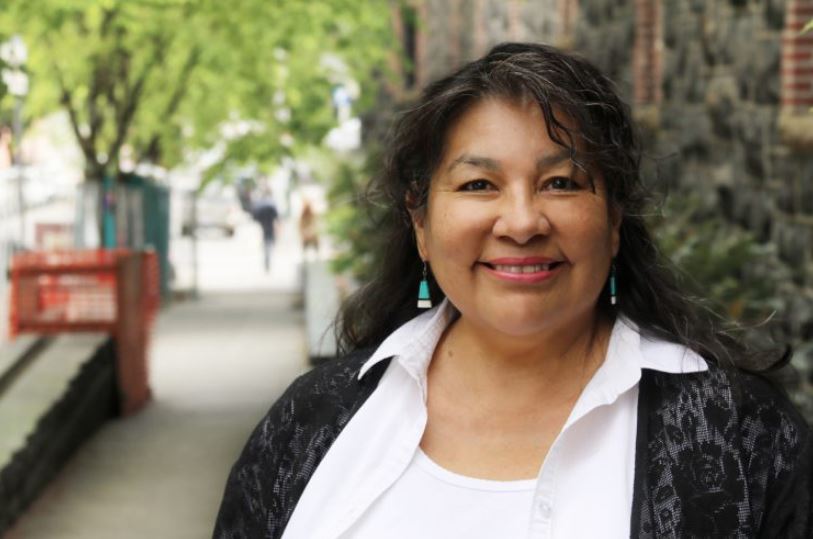
Francene Blythe-Lewis (Eastern Band Cherokee/Sisseton-Wahpeton Dakota/Navajo) serves as the president and chief executive officer of Vision Maker Media – an organization founded by her father, Frank Blythe. (Photos courtesy of Vision Maker Media)
By SCOTT MCKIE B.P.
One Feather Asst. Editor
For the past 50 years, Native American filmmakers have had their visions seen and voices heard through an organization now known as Vision Maker Media.
Francene Blythe-Lewis (Eastern Band Cherokee/Sisseton-Wahpeton Dakota/Navajo) serves as the president and chief executive officer of Vision Maker Media – an organization founded by her father, Frank Blythe.
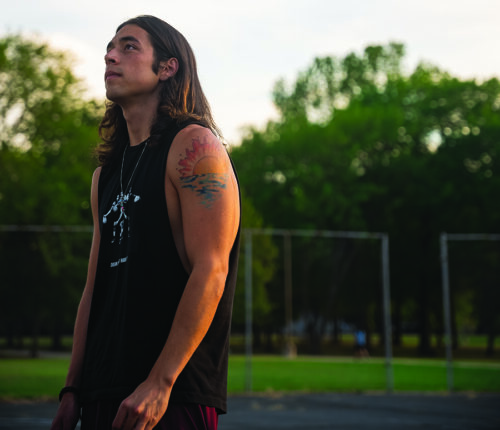
This still, from Vision Maker Media’s new series “First Peoples, First Stories”, is from an episode entitled “The Love for the Game” by filmmaker Josiah W. Jones (Apache, Chickasaw, Ohkay Owingeh, Kiowa).
She commented, “As we look to the future, Vision Maker Media is focused on expanding where and how Native stories are shared—across platforms, with new audiences, and a commitment to supporting emerging filmmakers. At the same time, the focus is about staying grounded, ensuring our stories remain personal, immediate, and connected. We’re building upon my dad’s legacy while incorporating space for the next generation to carry the organization forward.”
Starting in 1976 under the name Native American Public Broadcasting Consortium, the organization has dedicated itself to its vision, “A world changed and healed by understanding Native stories and the public conversations they generate.”
The organization changed its name in 1995 to Native American Public Telecommunications and again in 2013 to its current name of Vision Maker Media.
The late Frank Blythe (Eastern Band Cherokee/Sisseton-Wahpeton Dakota) was the founding executive director. Information from Vision Maker states, “Frank Blythe envisioned an organization that not only placed Native stories on public television and radio, but fundamentally changed who controlled the narratives. At a time when Indigenous perspectives were largely absent from media, Frank Blythe built the infrastructures, partnerships, and funding mechanisms needed for Native people to create, produce, and distribute films. He was instrumental in establishing Native media as a recognized and valued field, creating unprecedented opportunities for Native storytellers, producers, and broadcasters.”
Vision Maker Media is always looking to the future.
Raphael Reagan (Eastern Band Cherokee/ Sisseton-Wahpeton Dakota/Navajo) is the grandson of Frank Blythe. “I think that Vision Maker Media is going to be a leading force in digital storytelling with Native Americans. Specifically, I think gearing a lot of the younger generations into storytelling about their history, their community, and bringing that back within their own communities to share.”
Eric Braat, Vision Maker Media engagement coordinator, commented, “I think right now is pivotal that we work on outreach and we work on expansion and reach a younger and global audience and just drive awareness into everything that we have that may not be being showcased currently and extend the life of our films and our filmmakers beyond the broadcasts and position Vision Maker Media as a cultural leader for also the younger generation.”
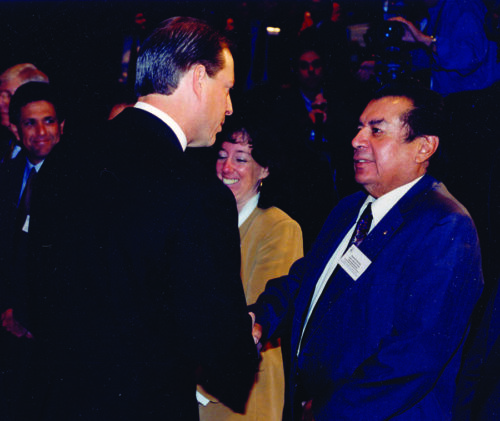
Frank Blythe, right, founding executive director of what would become Vision Maker Media, is shown meeting with former vice president Al Gore.
Phil Hoffman, Ph.D., is the chief executive officer for New Mexico PBS and a Vision Maker board member. “I think there’s two things about the next 50 years. First, I spent a lot of years as a journalist and every day you’re actually writing the first draft of history when you’re a journalist. I think that is an unparalleled thing that Vision Maker has done over the last 50 years. The stories that we have captured, the voices that have been empowered over the last half a century have created an incredible collection of material that is truly the first-person history for a lot of the Native organizations that have been part of that.
I think, secondly, for the next 50 years, a lot of work that we don’t necessarily talk about or hear as much is the work with young people. I look at that as the next 50 years…the opportunitities continue on so they get the opportunity to tell stories as they mature and as their talents mature, hopefully becoming really powerful storytellers when they get into their adult years.”
Jackie Swift (Comanche/Fort Sill Apache), is the Vision Maker Media board co-chairperson. “I think it’s time, from a Native perspective, to stand up and take that lead and be that front visionary to help make that stand. What is that process to differentiate the Media’s identity so that it’s not D.E.I, it’s not defined as D.E.I. There is a unique status there and that should be celebrated and recognized and a lot of education about that so that it doesn’t get blindly looped in to other things.”
She said a production entitled “She Cried That Day”, which centers the issue of MMIW (Missing and Murdered Indigenous Women) in one family, is a great example of how Vision Maker Media is fulfilling its vision.
Swift said a public tour to promote the film is currently ongoing. “When they’re going to communities, both Native and non-Native, they have their mental health professionals to help with anybody within the community that are experiencing or have experienced an incident with a murdered missing Indigenous person. They also talk around the context of the trauma, but also the path towards healing, recovery, and possible activism by changing policies and laws within their local communities or the states that they’re touring to. That is really a perfect example, a best description of a world changed and healed by understanding Native stories.”
Lynn Palmanteer-Holder (Confederated Tribes of the Colville Reservation), Vision Maker Media board, noted, “Bridges are being built in partnership. And the way that we’re able to communicate that is through the mediums that Vision Maker has provided. I’m excited to be a part of this and witness what’s happening. But, more importantly, I’m more excited as a daughter of a tribal leader who fought for self-determination and sovereignty for decades.”
She added, “I’m just excited to witness this organization be able to promote and sponsor spaces for Indigenous voices to be able to share that knowledge.”