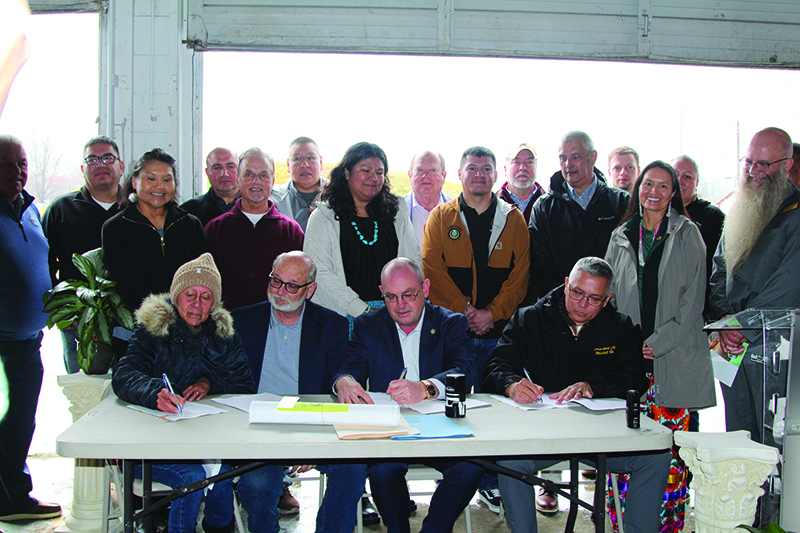
Juanita Wilson, Bob McCollum, Mayor Stacy Guffey, and Ugvwiyuhi Michell Hicks sign the deed transferring ownership of the Noquisiyi Mound to EBCI.
By ROBERT JUMPER
One Feather Editor
FRANKLIN, N.C. – Elaine Eisenbraun, executive director of the Noquisiyi Initiative, began the celebration with a short narrative of the long road to transferring the Noquisiyi Mound back into the hands of the Eastern Band of Cherokee Indians (EBCI) on Thursday, Feb. 26.
See the signed deed here.
Roger Smoker, an elder of the EBCI of the Tsalagi Gadugi/Tutiyi (Cherokee County/Snowbird) Community led the assembly of roughly 250 in prayer, facing east and speaking the prayer in the Cherokee language.
Clouds and rain could not dampen the spirits of those in attendance. Protected by the large garage bay on the Mound property and in the shadow of the Noquisiyi Mound, Jarett Wildcatt, a member of the EBCI, provided a moment of meditation and reflection as he played flute for the assembly.
Dinilawigi (Tribal Council) Tsalagi Gadugi/Tutiyi (Cherokee County/Snowbird) Rep. Adam Wachacha gave opening remarks. He expressed appreciation to those in the Noquisiyi Initiative, the Franklin mayor and aldermen, and the Tribe for the work that led to the signing of the deed over to the EBCI.
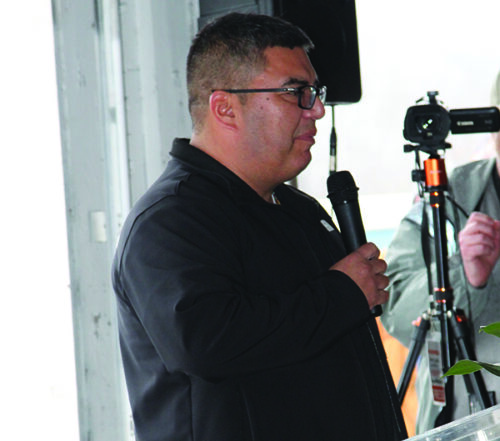
Dinilawigi (Tribal Council) Tutiyi/Tsalagi Gadugi (Snowbird/Cherokee Co.) Rep. Adam Wachacha gave an opening address to the gathering for the Mound signing ceremony.
Taline Ugvwiyu (Vice Chief) Alan B. Ensley then recognized members of the Dinilawigi, representatives of the Town of Franklin government, and the members of the Noquisiyi Initiative board. He thanked them for continuing to work together until the signing could be accomplished. Taline Ugvwiyu Ensley noted that Ms. Eisenbraun had shared a vision of the creation of the Noquisiyi Mound possibly happening one handful of dirt at a time. He said that, while attending a Fading Voices Festival, one of the observances was to circle the mound, with each tribal member holding a turtle shell containing a small amount of dirt. It reminded him of the time, dedication, and commitment that each generation had to the land and to the Cherokee people.
Those who were present to sign the deed transfer included Ugvwiyuhi (Principal Chief) Michell Hicks; EBCI member Juanita Wilson and Noquisiyi Initiative Board of Directors co-chair; Bob McCollum, Noquisiyi Initiative Board of Directors co-chair; and the Honorable Stacy Guffey, Town of Franklin Mayor. Each was allowed to share thoughts on the signing.
Wilson shared her own personal challenges that correlated with the long societal and legal journey to the Mound acquisition. She talked about the need for perception change when talking about the history of the Mound and the differences of opinion over who should be caretakers.
She said, “We tried to make this controversy over the Mound a good thing. We decided that ‘the politics’ wasn’t for us. As a group (of both tribal and Franklin town members), we set about learning about each other, Franklin people, Macon people, Cherokee people. We learned that there was so much love and dedication to this Mound, even when it was not under our stewardship.”
McCollum spoke of the many partnerships that were developed to facilitate the discussion and ultimate transition of the Mound. He named the members of the Noquisiyi Initiative board which included, in addition to Wilson and himself, Fred Alexander, Justin Setzer, Angelina Jumper, Dr. Barbara Duncan, Bo Lossiah, Gina Meyers, Tonya Carroll, Ty Boyd, Nancy Taylor, and Dawn Arneach.
“Our board is 50/50; members of the Cherokee community and the other half are from the Franklin/Macon County community. Today is a testament to what people can do if they work together.”
Mayor Guffey thanked the Franklin Town Council for its unanimous vote to remove stipulations that would have prevented or delayed the transfer of the Mound to the tribe. He also thanked the town’s administrative staff.
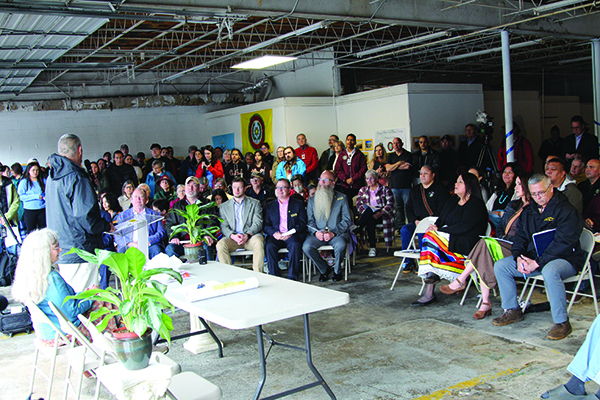
Approximately 250 Cherokee people, joined by Franklin and Macon County community members, attended the Noquisiyi Mound deed signing.
He spoke of the importance of how we view land and its sacred value. “That feeling, the sacred connection to the land, the belief that you don’t hold it for yourself. You hold it for your children and their great-grandchildren, is something that we share.” He spoke to the return on investment for Franklin of transferring the Mound back to the Cherokee people. “You know, we too often try to measure things in dollars, and cost, and profit, and short-term gain. If you ask me what the economic benefit is to Franklin for returning the Mound, the honest answer is that I don’t know. And further, I don’t care. Because that was never the point; the reason this (town) council voted unanimously was to do the right thing”.
Mayor Guffey said, “Sometimes the soul of a place is worth more than a parcel of land. Wouldn’t our world be a better place if we led with that principle?”
Ugvwiyuhi Michell Hicks recognized the Dinilawigi, past and present, for their work and diligence in making the day happen. He acknowledged all those involved in seeing that the signing is occurring.
“As tribal leaders, we have a responsibility to govern, not just in the present, but to protect what truly defines us as a tribe. What truly defines us as a sovereign nation.”
Ugvwiyuhi Hicks spoke to the Cherokee history of western North Carolina and particularly the Franklin area, stating that this area was where much of the cultural exchange with early Europeans took place. “The Noquisiyi Mound is not just a piece of land. It is a part of us. It is a part of the Cherokee people. It was torn away. We lost ownership of the land 207 years ago. It’s our responsibility to start tying the pieces back together. This is not a land transaction today. You (the town of Franklin) are sharing part of our history with us. You are bringing back just a piece of who we were.”
With that, the officers of the Noquisiyi Initiative (deed holders), the Mayor of the Township of Franklin, and Ugvwiyuhi Michell Hicks signed the deed over to the Eastern Band of Cherokee Indians.
Prior to the 2020s, the Noquisiyi Mound was known as “Nikwasi”. A short history (courtesy of Tsodani Ugama): “Nikwasi was Nikwasi when we Aniyvwiya got here to this area. Nikwasi is a burial/platform mound. The Mound has never been the subject of a destructive major archaeological excavation and is the largest unexcavated mound in the Southeast. Nikwasi is the home to a race of people called the Nu-Ne-Hi, who are immortal beings that sometimes come to protect the inhabitants of the area. Nikwasi was forcibly taken from our care and from our ceremonies by Europeans who desperately wanted the land.”