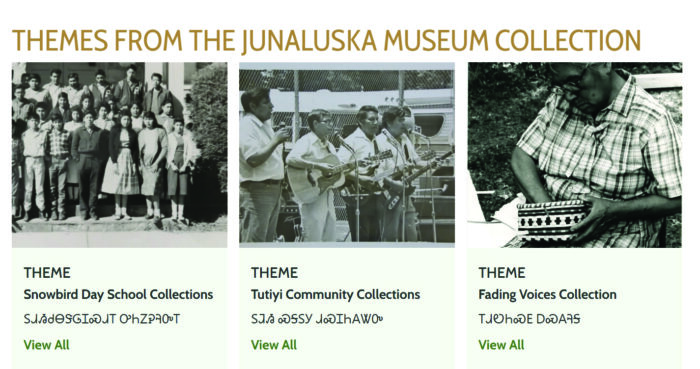
The Junaluska Museum has been working recently on a project to bring its collection online and the story of the people of Tutiyi (Snowbird) alive. (Screenshot from webpage)
By SCOTT MCKIE B.P.
One Feather Asst. Editor
TUTIYI (Snowbird) – The Junaluska Museum has been working recently on a project to bring its collection online and the story of the people of Tutiyi (Snowbird) alive. As of this printing, there are 129 records divided into three categories (Snowbird Day School Collections, Tutiyi (Snowbird) Community Collections, and Fading Voices Collection).
The online collection can be seen here: https://junaluskamuseum.ebci.gov
Angelina Jumper, a member of the Eastern Band of Cherokee Indians (EBCI) and Junaluska Musem cultural resources supervisor, speaks to the impetus behind the project. “Since 2015, the Junaluska Museum has been without a physical space. Much of our collection has lived in off-site storage, we also had a growing amount of digital media that hadn’t been properly digitized, organized, or preserved. All at the same time, our community was asking for access to family photos, historical materials, and shared memories.”
She added, “That combination with limited physical access and an urgent need for preservation is what pushed us toward going digital. Initially, we envisioned a simple, accessible online archive so we could start sharing what we already had with the Snowbird community. But as we began the process, we realized we needed something much more comprehensive, a system that respected Tribal data sovereignty and could support long-term stewardship, not just public-facing access.”
Jumper said the project was only possible through their partnership with the EBCI OIT (Office of Information Technology) and Terentia, which is a company whose mission statement reads, “Empowering museums and cultural institutions with next-generation solutions for DAM (digital asset management), collections management, and collections engagement.”
Jumper commented, “What started as a goal to build a digital archive became a full digital asset management system designed around our values and needs as a tribal museum. Terentia provided us with a data-sovereign platform that allows us to store all forms of media: photographs, documents, oral histories, and more, in a way that works for us. It’s not just about displaying content; it’s about caring for our materials, and interpreting them, our way.”
Kayleen Cree Rockwood, an EBCI tribal member and Junaluska Museum cultural coordinator, added, “The Tribe’s IT department had reached out to us about a potential digital assets management system, which would allow us to digitize our collections and store them in a centralized location, but also allow us to create virtual exhibits for the community.”
Jumper, from Tutiyi herself, said the main goal of the project is to enhance the history of Tutiyi and its families. “Our primary goal is to give the Snowbird community access to their family photos and shared memories while preserving as much archival material as community members are willing to entrust to us. We built this system from the ground up, especially when it comes to metadata, permission levels, and collection labels.
Instead of forcing us into a standard museum template, the Terentia team worked with us to design a structure that fits a small Tribal museum holding community-based collections. We can now create individual collections for community members and search by family connections or even the different smaller communities within Snowbird. Historical documents can be organized by time period, community, or a person’s role. We can label whether they were Tribal officials, community club members, or day school students. We’re essentially able to build living profiles that connect photos, documents, and oral histories, allowing us to tell fuller life stories rather than just catalog objects.”
There is much more to come on this project.
Jumper noted, “We’ve been working closely with our IT department to explore what’s next. We recently partnered with TimeLooper to create a prototype virtual exhibit, Rooted in Resistance (timelooper.com/eastern-band-cherokee), which debuted at the ATALM (Association of Tribal Archives, Libraries, and Museums) conference last year. That experience gave us our first real look at what immersive virtual exhibits could be, and it confirmed that this is likely the direction we’re heading. Digital preservation is the foundation, but virtual storytelling is where we see a lot of future potential.”
One of the processes involved as the project evolves is photogrammetry which is defined as “a process for determining geometric properties and distances from two-dimensional photographic images”.
Jumper said that has been a learning curve. “Any new technology comes with challenges, but seeing artifacts come to life through photogrammetry makes it worth the hundreds of photos required to capture every angle. We started using an iPhone 16 Pro and have gradually moved into DSLR cameras to achieve even higher-resolution results. We’ve had tremendous support from the Terentia team throughout this process, especially on the photogrammetry side, which really shows how hands-on and collaborative their approach is.”
Rockwood noted, “Learning photogrammetry has definitely been a learning experience. Since we have no experience with this type of technology, we learned how tedious the process can be. We have scanned several physical artifacts from our collections. Once we learn to use AgiSoft, we will put those artifacts in our collections online.”
This project has helped bring Jumper and Rockwood closer to the community they work in.
Jumper commented, “This project has deepened our understanding of the interconnected families, histories, and lived experiences within Tutiyi. As materials are brought together digitally, we are discovering connections between people, locations, and events that were not always visible before. The process has revealed the richness of the community’s story and reinforced the importance of preserving everyday memories alongside formal historical records. It’s also reinforced how much knowledge lives within the community itself. Many items gain meaning only when families share context, names, and stories, reminding us that archives are strongest when they’re built collaboratively. My favorite part about this work is when we are identifying people and someone tells me a good story about one of my great grandparents and how people today remember them as a community member back in the day.”
Rockwood said, “I am not from this community. I was born and raised in Cherokee. Since moving to Snowbird, I have learned how deep and rich the history is here. The community was built on resilience, and its members show it every day. My hope is that people want to learn about Snowbird’s history, and that we can help with that at The Junaluska Museum.”
Jumper is excited about the future of the project. “This project is reshaping what the Junaluska Museum can be. Without a physical building, we’ve leaned into becoming a digital-first, community-centered museum that prioritizes access, sovereignty, and relationship-building.
The system we’ve created allows us to preserve materials responsibly, tell more complete stories, and engage younger generations through digital and virtual platforms. It also positions us for future growth, whether that’s expanded virtual exhibits, deeper community partnerships, or eventually reconnecting digital collections with a physical space. Most importantly, it ensures that Snowbird’s history remains in Snowbird hands where it is preserved, organized, and shared according to community values.”