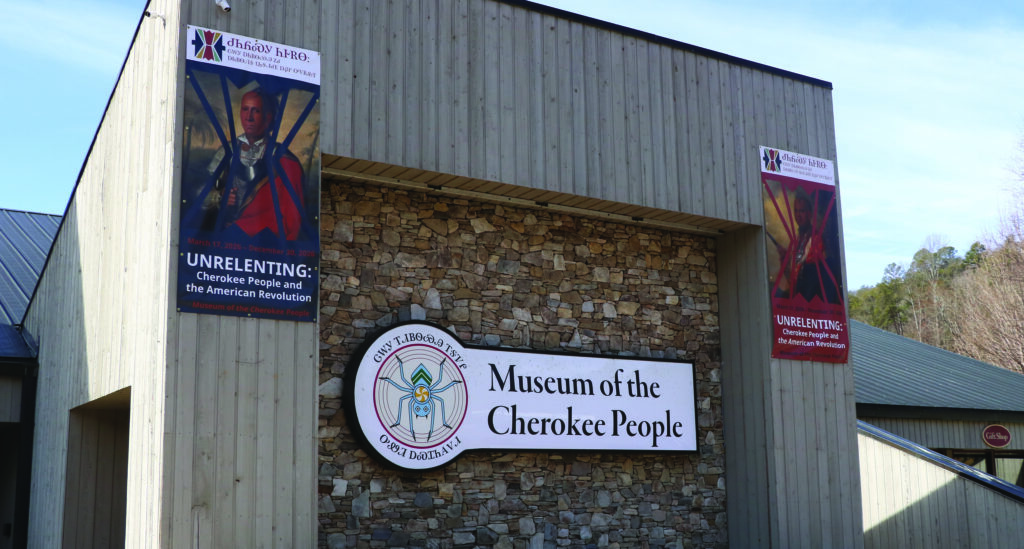
Signs in the front of the Museum of the Cherokee People in Cherokee, N.C. advertise a new exhibit opening on Tuesday, March 17 entitled “Unrelenting: Cherokee People and the American Revolution”. (SCOTT MCKIE B.P./One Feather photo)
By SCOTT MCKIE B.P.
One Feather Asst. Editor
CHEROKEE, N.C. – The United States of America is celebrating its 250th anniversary this year, and the Museum of the Cherokee People is dedicated to making sure that a Cherokee voice is included. The Museum is set to open a new exhibit on Tuesday, March 17 entitled “Unrelenting: Cherokee People and the American Revolution”.
Shana Bushyhead Condill, Museum executive director, said the title is very purposeful and took a lot of thought and brainstorming from herself and Museum staff. “The message that we’re trying to get across with the title is that every time we’re making a decision, it is about our connection to land and where we are.
Our connection to land is unbroken, and will never be broken, ever. So, no matter what, whatever time frame that we’ve been in since contact – or even prior – it’s never been broken. So, that was important to us. Then, the other piece of that, the resilience piece of it, or the unrelenting piece of it gives action to Eastern Band folks as actors. So, it’s not just that we were getting our fields burned and being murdered, we were doing things as well. So, we were actors in that story. Typically, when you’re looking at history from that time period…it’s romantic.”
She added, “We know that there were many, many people taking all kinds of action to ensure that we could stay here on our ancestral homelands. So, it’s unrelenting – the action that our people take to keep us here still today.”
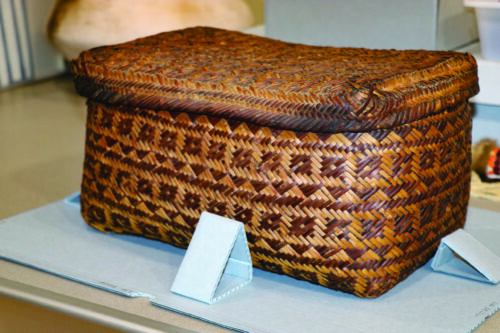
This exquisite lidded doublewoven rivercane late 18th century basket, photographed in the Museum of the Cherokee People archive on Tuesday, Feb. 17, will be part of the “Unrelenting” exhibit.
The Museum hosted an open call for proposals inviting artists to submit art to be considered for inclusion in the exhibit so that contemporary voices can be visualized interpreting past events. These include some EBCI artists such as: Joshua Adams, Aaron Lambert, Louwana Jo “ᏍᎩᎵᎡᏆ” Montelongo, Qualla (Paula) Nelson, Isabella Saunooke, Laura Walkingstick, Tara White, and Alica Murphy Wildcatt. Other artists include: Beth Anderson (Cherokee Nation), Karen Berry (Cherokee Nation), Martha Berry (Cherokee Nation), Anagali Shace Duncan (Cherokee Nation), Keli Gonzales (Cherokee Nation), and Robert Lewis (Cherokee Nation, Navajo Nation, Apache).
Dakota Brown, Museum director of education, commented on the exhibit’s message. “For us, as Cherokee people, our stories are often told for us. I think that this is a common theme that we come up against here at the Museum. We haven’t had the opportunity to tell a Cherokee perspective of the Revolutionary period, and I think it’s time for us to be able to add that lens to what this looks like.
I wish we could tell more than what we have the space to tell, but we just have a few walls in that space to be able to tell the story and lay the groundwork. That’s how I’ve pictured this exhibit to be. We haven’t been able to lay that groundwork yet, and this is our opportunity to be able to do that, to tell the story from our perspective.”
Condill commented, “One of the goals for the exhibition, not only is it to make people more complex – it’s not just a good guy, bad guy situation – but also that this context of warfare for generations was also really important for us to get across. Since 1711 – and you could go further back to contact – we’re in a constant state of anxiety, ready to fight or ready to defend. What is that like feeling that way for generations, and how does that impact who we are today? We talk about what generational trauma is, and I think we’re typically going back to forced removal, but even before that, there was a lot of crazy happening in our home.”
Brown added, “Not only do I want to tell a Cherokee story, but I want it to be a little richer and a little bit fuller than just what happened in military actions. What are the stories and what are the whys behind these moments that make them impactful for us today. That, to me, is always important – bringing that through – thread to today. How does it still impact us? Because it does, and that’s one of the things that talking through this period and seeing how all of these things, all of this land loss, we can look at the land that we have today as a direct result of that period and the continued actions after that. I think being able to look at those time periods and see how they impact us, as Eastern Band people, today is important for me.”
Martha Berry, a Cherokee Nation citizen, has contributed a beaded bandolier bag, entitled “When the Highlands Met the Mounds”, to the exhibit which she says honors her Cherokee heritage as well as the Jacobites, Scots who rebelled against the British.
In her artist statement on the piece, she noted, “The first Jacobite to marry into my Cherokee family came at the time of the American Revolution. Seven generations later, a descendant of another Jacobite family, the Grahams, turned up in Tulsa almost exactly two centuries later. His family had fled Scotland, moved to Ireland and changed their name, then meandered to Canada, Chicago, Kansas, and finally Oklahoma. In 1972, he met and married this Cherokee girl.
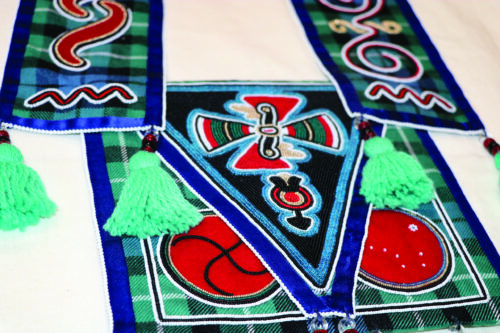
Martha Berry has contributed a beaded bandolier bag, entitled “When the Highlands Met the Mounds”, to the exhibit which she says honors her Cherokee heritage as well as the Jacobites, Scots who rebelled against the British.
The materials and symbolism of this piece tell these stories. The wool fabric is the ‘Graham of Montrose Ancient’ clan tartan. The bead designs are adaptations from artifacts found in the mounds of the Southeastern United States. The symbol on the pouch flap represents ordinary soldiers. Also depicted is the Sun, and the Ursa Major constellation and Polaris, the North Star.”
Brown said they hope people gain a new perspective on the time period of the American Revolution upon visiting the “Unrelenting” exhibit.
“I think there were really complex decisions being made and some I agree with and some of them I don’t,” she said. “But, I think, as a Cherokee person, I feel proud of the folks that were trying to do what they thought was right in those moments. So, I hope for Cherokee folks it’s pride, but I do think that maybe our other visitors that are coming through here might feel a little taken aback by the approach that we’re taking with this.
I really wanted to be very direct and very honest about the way that I saw that period…I hope that they leave our exhibit and enter into our exhibit with an open mind, curiosity, to hear what a Cherokee side could look like, or what a Cherokee side can look like from that period.”
For more information on the Museum of the Cherokee People, visit: https://motcp.org