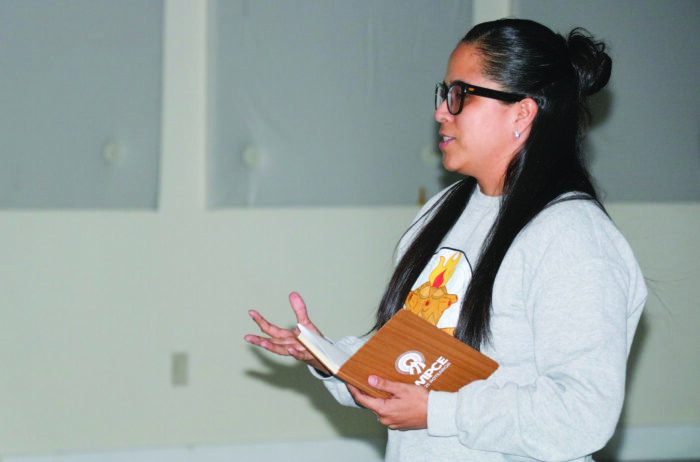
During a group presentation at the Yellowhill Activity Center in Cherokee, N.C. on the evening of Tuesday, Jan. 27, Kelly Murphy, a member of the Eastern Band of Cherokee Indians (EBCI) and a language specialist at New Kituwah Academy, speaks about her experiences as part of the EBCI contingent to the 2025 WIPCE (World Indigenous Peoples Conference on Education) held in Auckland, New Zealand. (SCOTT MCKIE B.P./One Feather photos)
By SCOTT MCKIE B.P.
One Feather Asst. Editor
CHEROKEE, N.C. – Indigenous educators from throughout the world gathered in Auckland, New Zealand last fall for the 2025 WIPCE (World Indigenous Peoples Conference on Education), and the Eastern Band of Cherokee Indians (EBCI) was well represented. EBCI attendees at the Conference spoke about their trip and what they learned during a presentation at the Yellowhill Activity Center in Cherokee, N.C. on the evening of Tuesday, Jan. 27, 2026.
Information from WIPCE states its mission is “to honour, preserve, and advance Indigenous education by uniting Indigenous educators, leaders, and knowledge keepers worldwide”. The organization states that over 3,800 people attended the 2025 Conference.
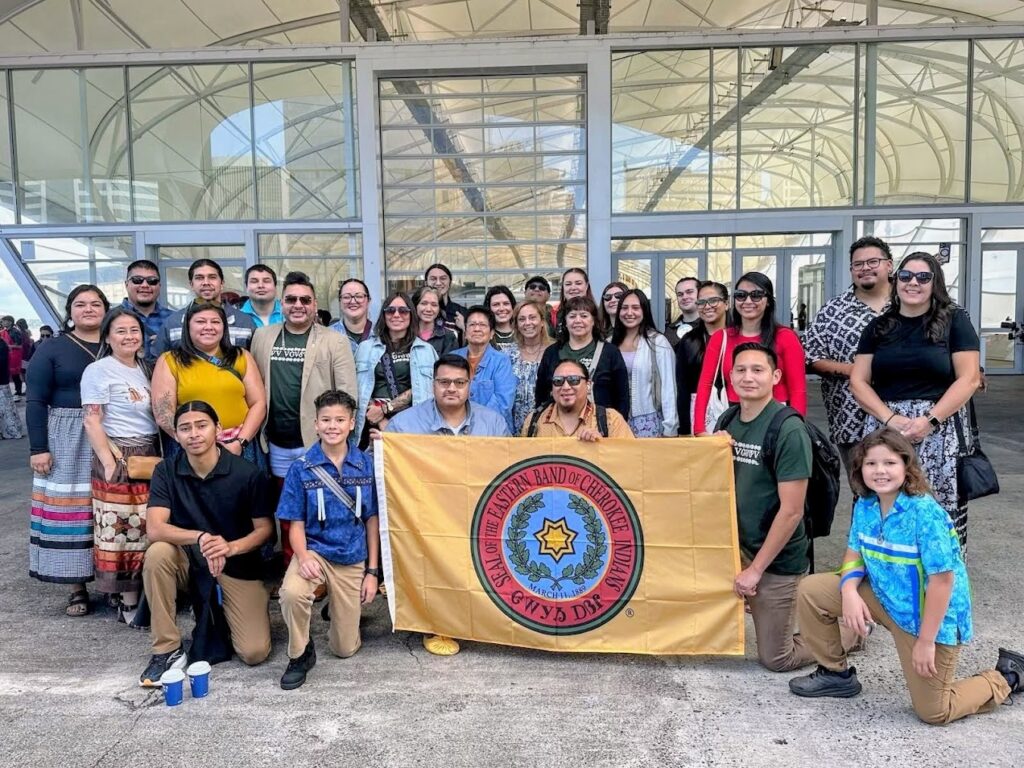
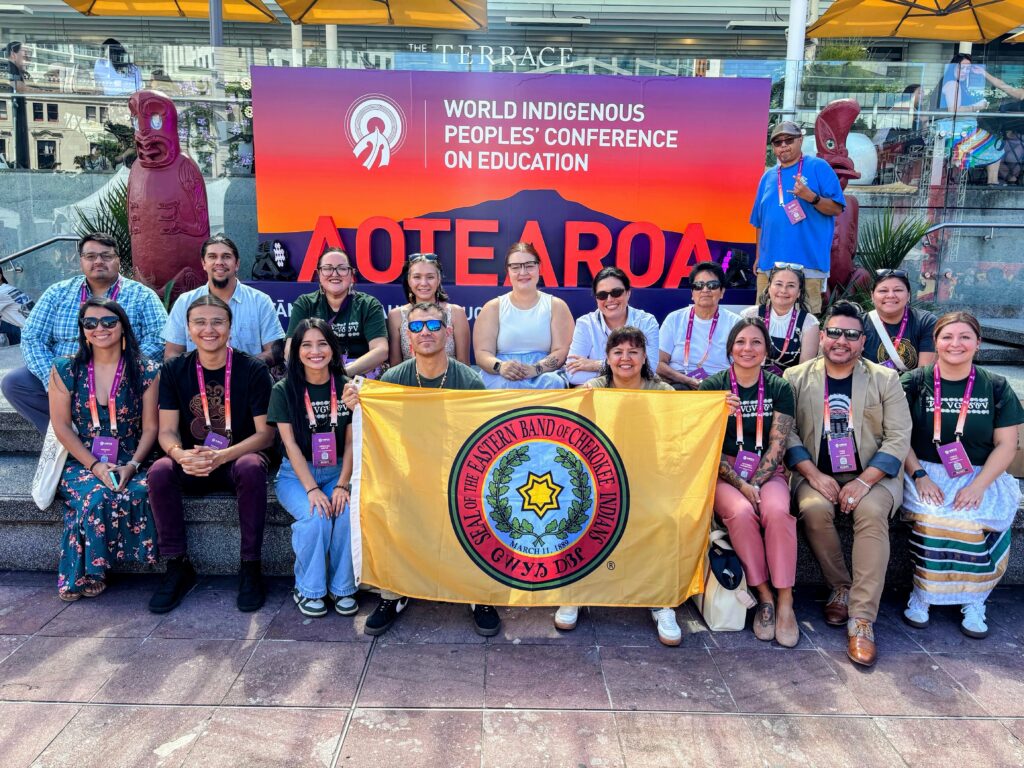
Tonya Carroll, an EBCI tribal member who is the department manager at the Ray Kinsland Leadership Institute (RKLI), provided the following information regarding the EBCI attendees. “The Harrah’s Cherokee Tribal Scholarship Fund provided financial support through RKLI for 25 participants including Raylen Bark, Tonya Carroll, Jack Cooper, Nichole Efird, Landon French, Cassidy Galaviz, Consuela Girty, Hope Huskey, Angelina Jumper, Darius Lambert, Dreyton Long, Faith Long-Presley, Madison Long, Meshay Long, Tara McCoy, Kelly Murphy, Elnora Nations, Keyonna Rodriguez, Aaliyah Swimmer, Ashford Smith, Michael Thompson, Catcuce Vernon Tiger, Yona Wade, Elvia Walkingstick, and Levi West. Additional EBCI and Cherokee community members also attended through independent travel or other funding sources including Dr. Beau Carroll, Jennifer Martens, Jakeli Swimmer, Tribal Councilwoman Shannon Swimmer, Micah Swimmer, Truman Pipestem, Catcuce Micco Tiger, Shaligugi Tiger, and Katie Tiger.”
Carroll said, “They earned this trip by the work they’re already doing in the community – by the passion that they already have, by the roles that they’re already in. Our goal was to take a diverse group from the community, and you can see we had representation from tribal programs, from the community, from the schools, from the hospital, from the Boy’s Club. So, I think being able to do this as a collective group and share these experiences is going to help us as we come back and we do our projects.”
The EBCI contingent was a diverse group of educators and Cherokee language speakers and learners. Several of them spoke about their experiences in New Zealand – both at the Conference and on various visits to Maori spaces while there.
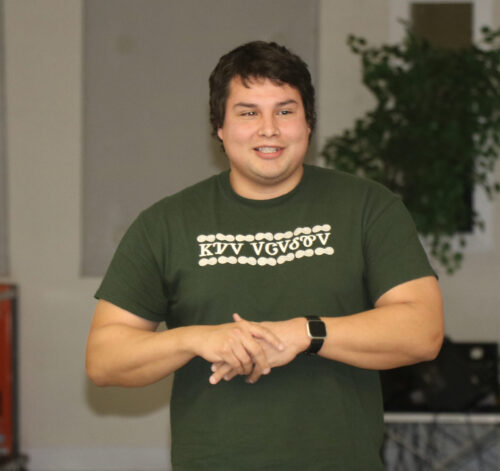
Landon French, an EBCI tribal member and a teacher at New Kituwah Academy, speaks about his time in New Zealand.
Dreyton Long commented, “The one thing that really stood out to me was, we visited one of their immersion schools where they brought up toddlers up to third or fourth grade. They made a point – they said that they base none of their curriculum on any state senator or any typically westernized standard…They’ve based their entire curriculum off of their local environment from their homelands so that their children will grow up to have a connection to where they’re actually from.”
Elvia Walkingstick said, “What I’m taking away from New Zealand is the community piece that they built for themselves. One generation ago, they made up their mind, as a community, that this is what they were going to do, that they weren’t going to ask the government, they weren’t going to ask people even within their community for permission. They were just going to identify exactly what they knew that they needed to do and then do that. So, the people we were meeting had been raised with that mindset, so they watched their grandmothers, their mothers, their fathers put in the work – hold that space for themselves and their community to create these nests for themselves. They had to built it. They didn’t just exist.”
Madison Hye Long said she learned a lot but was most impressed with the model of land-based learning especially as it pertains to language. “I can relate to that because I grew up in the woods and I learned a lot of stuff that you can’t get in a classroom. I think that’s really important as a Cherokee individual. So, maybe creating language land-based camps…to where we’re stepping away from a classroom setting and then learning the language in our natural setting.
They don’t teach the language, they feed it. That just stuck out to me, so we’ve got to do that to our community. And, I think when we go for the aspect of feeding it instead of just teaching it, we do it with more love in our hearts.”
Mike Thompson said the trip was enlightening and empowering. “I was sad to see that every culture represented there is going through the same stuff. But, I was happy to see we weren’t the only ones going through the same stuff. It’s all of us.
A lot of the stuff I learned is that we’re going to have to do it ourselves – not ask for permission, just get out there and start going. It’s also on us. If you want access to the language, you’ve got to ask and demand it because there’s not a lot of language resources out there besides a few community classes.”
Consuela Girty, Cherokee Central Schools superintendent, stated, “As I lead Cherokee Central Schools, my hope is that we create a space that our students and our children know who they are when they leave us – they’re confident in their Cherokee identity.
We have moved in a direction where I want to integrate the language as whole-heartedly as we can – less of a silo. It’s not ‘we’re going to go to Cherokee language class’, it’s ‘Cherokee language is in every class’.”
Superintendent Girty added, “Every presentation by a Maori individual was given to us in their language. For the first ten minutes they would talk in nothing but their language and they were unapologetic about it.”
Kelly Murphy is a language specialist at New Kituwah Academy. She commented, “Each session, from the opening session to the very last session, was mind-opening not only as a second language learner, but as a Cherokee woman.
The experience was transformative, not only because of the ideas shared, but because of the urgency behind it.”
In speaking about the work of teaching and sharing the Cherokee language, she noted, “The work we do today determines whether our language survives tomorrow…unless we do the heavy work, the next generation won’t be able to do what’s necessary to carry forward. That really stuck out to me because I feel like we’re making good strides, but there’s not enough of us. We’ve got to get everybody involved. We’ve got to get the whole community involved.”
Landon French is an elementary school teacher at New Kituwah Academy. He had the opportunity to explore Aukland and visited three museums including the Aukland History Museum. “In all these museums they had plaques up and they had Maori (language) first, English second. I thought, ‘wow, that’s a pretty big deal’.”
He added, “We all have the same ideas, we all saw the same stuff out in New Zealand. We all saw representation, language, everything and culture being represented, people not being scared to share their culture and being in your face about their culture. We all have the same ideas, but we’re not all working together as a community.”
Yona Wade is the head of learning development at Cherokee Indian Hospital Authority. “I travel quite a bit. But, when you have an opportunity to travel to go and share time with other Indigenous communities, it makes the travel entirely different. So, being able to go and visit other Indigenous peoples, to hearing how they’re trying to preserve their language, how they are continuing to ensure that their language stays present, how they continue to connect with their community, how they plan to preserve their culture, were all the pieces that I took from this trip.”
Carroll noted that each participant has to do a project where they improve something in the EBCI community – creating something new or improving something that already exists. “As a result of this, people are coming back and there is a direct impact on the community…the way that we improve and progress and share and save our culture and our language is through that community, is through asking people, ‘how can I help you? What role do I play?’. I think, hearing from everybody, they’ve brought back even a stronger sense of responsibility, even a stronger sense of the passion for whatever it is that they want to work to improve in the community.”
Some have already started on their projects.
For her project, Angelina Jumper, EBCI culture resource supervisor, has created “The Path of Junaluska” which she describes as “a self-guided tour booklet that guides you through the life of Junaluska and the many local places he once stood”.
Jumper said something that she took from the Conference was, “Culture is not bound by the walls that we exist in. If anything, it is actually outside the walls that we exist in and learn in every day.”
Below are several group photos provided by Carroll: