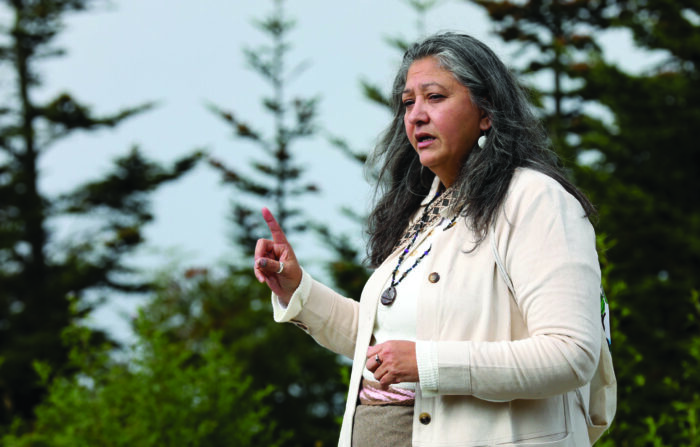
Nancy Pheasant, a member of the Eastern Band of Cherokee Indians, welcomes the students to the Kuwohi Connection Day with the story of Medicine Lake. The event was held at Kuwohi (Mulberry Place) in the Great Smoky Mountains National Park on the morning of Tuesday, Sept. 9. (SCOTT MCKIE B.P./One Feather photos)
By SCOTT MCKIE B.P.
One Feather Asst. Editor
KUWOHI – The low-hanging clouds, mostly blue skies, and brisk temperature made for a magical morning as area students attended Kuwohi Connection Day at Kuwohi (Mulberry Place) in the Great Smoky Mountains National Park on the morning of Tuesday, Sept. 9. The event was hosted this year by the Center for Native Health and featured educators from the Museum of the Cherokee People, EBCI (Eastern Band of Cherokee Indians) Cooperative Extension Office, and the EBCI Tribal Historic Preservation Office (THPO).
Another Kuwohi Connection Day event will be held on Tuesday, Sept. 16 and will start with the Community Kuwohi Celebration at 7 a.m. to commemorate the one-year anniversary of the name restoration. Several school systems are participating in this year’s Kuwohi Connection Days including New Kituwah Academy, Cherokee Central Schools, Graham County Schools, and Swain Co. Schools.
“There’s a reason we’re here this morning…there’s a reason we asked you guys to come up here,” Nancy Pheasant, an EBCI tribal member, told the students gathered. “You see, this place where we stand and we sit this morning is very sacred to the Cherokee people.”
Each student present received a tote bag emblazoned with artwork by Pheasant as well as a Kuwohi beanie.
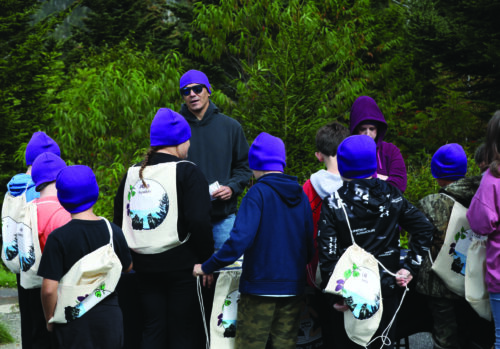
Beau Carroll, a member of the Eastern Band of Cherokee Indians (EBCI) and lead archaeologist for the EBCI Tribal Historic Preservation Office (THPO), explains to the students about the THPO program and the role of archaeology.
Pheasant referenced the recent name restoration of Kuwohi, an effort that was spearheaded by Mary “Missy” Crowe, an elder of the EBCI from Elawodi (Yellowhill), and Lavita Hill, an EBCI tribal member from Kolanvyi (Big Cove). “The reason this place had a name change was because the Cherokee have always known it as Kuwohi…the beanies that you have on have the word ‘Kuwohi’ written in Cherokee as well as phonetics, so you can always remember what this mountain is called.”
She went on to say, “The story that I want to share with you today is another reason why we think this mountain is a sacred space for the Cherokee. This is also known as a place for Bear Council, meaning that the Bear People, or the Bear Clan, once held councils here.
It’s not only a sacred space for the Cherokee, but it’s also a sacred space for the animals as well as the plants that surround us.”
Beau Carroll, an EBCI tribal member and EBCI THPO lead archaeologist, told the students, “Anything that’s important culturally, we are involved in and care for – special mountains like this place, rivers, mounds, archaeological sites, old towns, burials, historic cemeteries. We protect artifacts – tools, pottery, old baskets, carvings. We also protect stories and help keep language because that’s the way our people remember the past. Every story, artifact, that tells us who we are and where we came from. So, by protecting them, we’re able to pass it on to future generations.”
Dylan Morgan, an EBCI tribal member and cultural specialist with the Museum of the Cherokee People, sang several songs for the students to dance to including the Cherokee Bear Dance and the Friendship Dance. He commented, “This is a very special place to be. For us as Cherokee people, it’s an honor to get to come up here and dance again. If you think about it, a long time ago these dances were lost from this area, but now we’re getting to bring all these dances back…the mountains are alive. They do hear these songs. They know the presence of us being here.”
Rhonda Wise, former lead education ranger for the North Carolina side of the Great Smoky Mountains National Park, helped create the event after attending a webinar hosted by Trey Adcock, a Cherokee Nation citizen and executive director of the Center for Native Health.
Wise noted, “In 2021, we had to stop giving educational programs up here because of the sheer volume of people…the logistics of having 5th graders up here was not possible at the time.”
She added, “The idea from the beginning was to just give access to the Cherokee people to do whatever they wanted to up here…we already had some connections in the community…so we went to the people that we knew and already had relationships with and we were like, ‘here’s our idea. We have permission. Can you help us? Can you help us make this a thing?’”
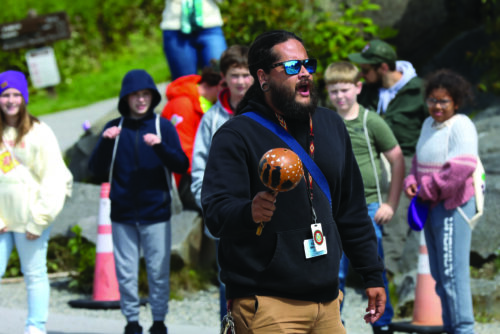
Dylan Morgan, a cultural specialist with the Museum of the Cherokee People and a member of the Eastern Band of Cherokee Indians, sings the Cherokee Bear Dance song for the students who got to participate in the dance.
Wise said partnerships have been at the forefront from the beginning. “They’ve continued to have it and it’s continued to grow. Now this year, it’s even more exciting to me because it feels like it’s come full-circle. With the Center for Native Health, with Trey Adcock at the helm, it feels like it’s come full-circle to me. The fact that it started with Trey and his webinar of instilling in people who are not Cherokee with the importance of this land. And now it’s back being run by an organization that he is in charge of. It feels very full-circle, and it is very exciting.
This is growing, and it’s going to adapt. And, it’s a living, breathing thing and I imagine every year it’s going to get more excitement, more interest, and it’s just going to grow.”
Bonnie Claxton, a member of the Chickasaw Nation of Oklahoma, is the deputy director for the Center for Native Health. She said, “This has been going on for years. The National Park Service and the Community Club Council, and the community group that was helping to organize Kuwohi had been doing that. Earlier this year, the National Park Service has been wanting to give this over to the community. So, they talked to a few different groups and the Center for Native Health was honored to be part of that. So, there are so many people who make this possible and our job was just to get everybody together regularly and call meetings and help move things forward, hold the money and make sure things can get paid for since we are a 501c3.”
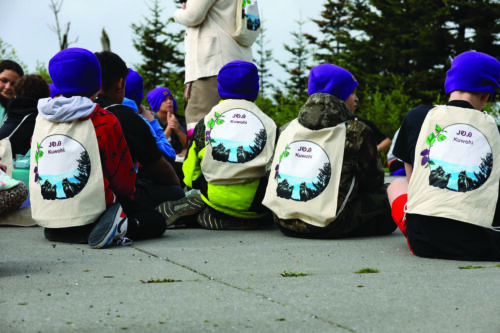
Each student at the event received a special Kuwohi backpack, emblazoned with a design by Nancy Pheasant, as well as a special Kuwohi beanie.
Claxton said the Center for Native Health is very happy to be involved in the event. “Our whole mission and vision are all about how culture is health. So, this is health. Even the ones of us that are just working here, to see these kids, so see them engaging with the place is medicine.”
She also spoke of the name restoration. “To me, I get chills looking at the signs where the name is restored because it takes back that sense of belonging and that sense of place that Native people have had in the United States for so long, but have been displaced from land in so many different ways. And, the way that government policies and specific targeted ways of trying to displace Native people has affected people’s health. Having to come into this park where everything is paved and is not the way that it used to be, it’s like you’re visiting your own ancestral homeland. So, to have that language restored, I think is really valuable.”
Claxton also thanked the National Park Service for their involvement. “I’m new to this this year, but to see the way that the National Park Service is engaging with the community is really beautiful because they really are leading from behind. They have so many staff here today. Their folks were down at the gate. They locked the gate for us, which is a huge deal, so that the kids can be here without a bunch of other folks around…A lot of those are volunteers and they’re here because of how much they acknowledge the fact that this is Cherokee land. And, they are so grateful to work with the community, and the way that they have shown up and not at all tried to impose what they think needs to happen, but really tried to listen and say, ‘here’s how we can support this’…I just think that the way they show up in this project has been really cool to see.”